How to Use Elliptical Trainers for Good Knees Safely
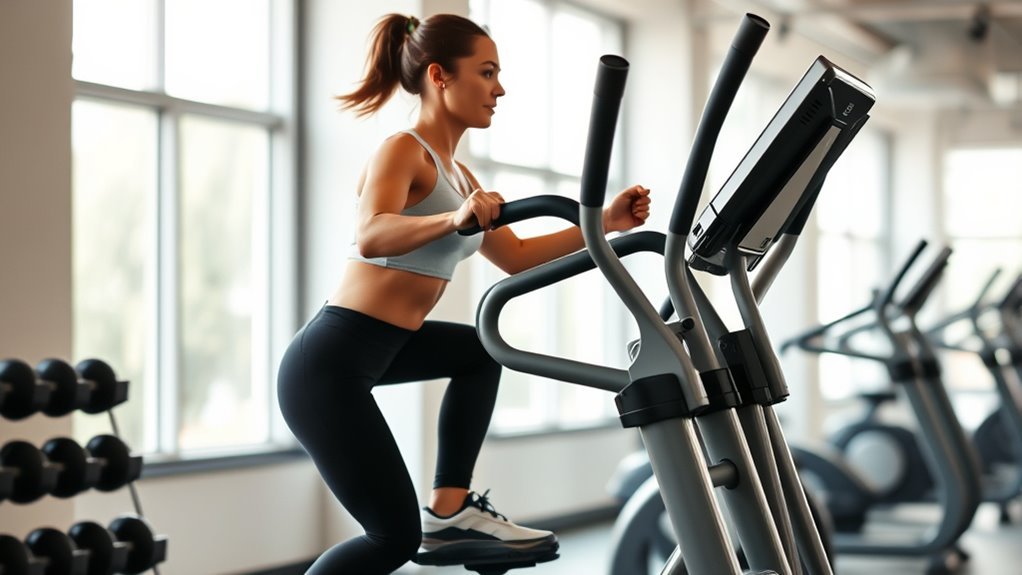
To protect your knees on an elliptical trainer, it’s important to keep your knees aligned over your toes and slightly bent throughout your workout. Using a smooth, controlled motion helps reduce unnecessary stress on your joints.
Make sure your feet are centered on the pedals with toes pointing forward to maintain proper form.
Start with a low resistance and moderate incline to avoid putting too much strain on your knees. Engaging your core during your elliptical session will help improve your overall stability and balance.
Don’t forget to warm up before hopping on the machine and cool down afterward to keep your muscles and joints happy.
If you ever feel discomfort in your knees, it’s a good idea to stop and reassess your technique.
Want to master safe elliptical techniques and learn more about knee care? Keep reading for essential tips to get the most out of your workout while protecting your joints!
Key Takeaways
- Maintain proper knee alignment by keeping knees slightly bent and tracking over toes during elliptical exercise to avoid strain or twisting.
- Start with low to moderate resistance and adjust stride length to match natural movement, minimizing joint stress.
- Use a smooth, controlled pedaling motion with feet centered on pedals, toes pointing forward, and avoid locking knees.
- Warm up for 5–10 minutes at low resistance and cool down with stretching to prepare and protect knee joints.
- Stop exercising if sharp pain or swelling occurs, and seek medical advice to prevent worsening knee injuries.
Understanding Knee Anatomy and Elliptical Motion
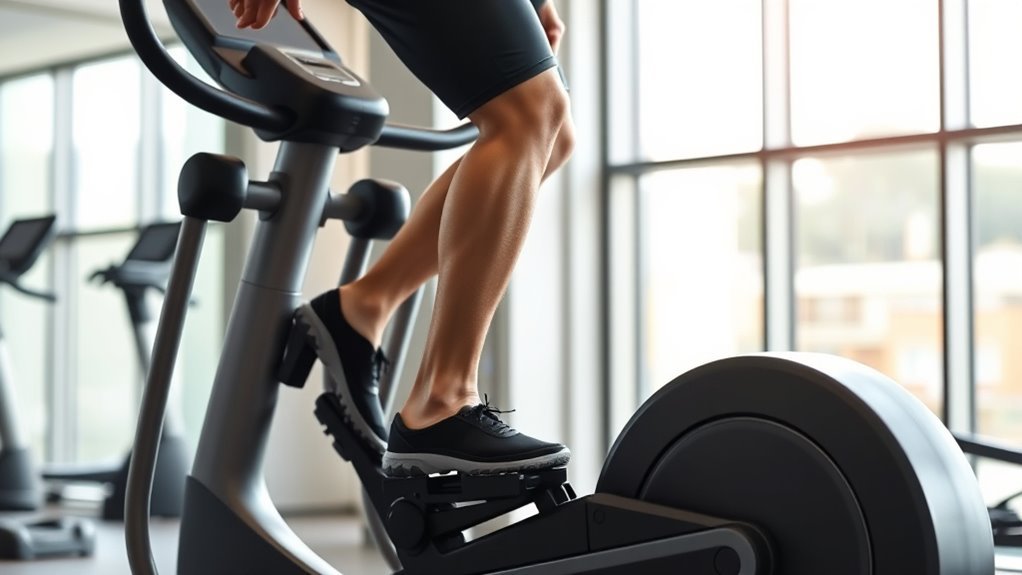
Before you hop on an elliptical trainer, it’s important to understand how your knee moves during exercise. Your knee is a hinge joint that primarily bends and straightens, supported by ligaments and cushioned by cartilage.
When you use an elliptical, your legs follow a smooth, elliptical path that mimics natural walking or running motions without harsh impact. This continuous, low-impact movement helps protect your knees by reducing stress on the joint surfaces.
However, you must maintain proper form to ensure your knees track correctly over your feet, avoiding twisting or locking. Knowing this anatomy and motion helps you appreciate why ellipticals can be gentler on your knees compared to high-impact workouts.
Choosing the Right Elliptical Machine for Knee Health
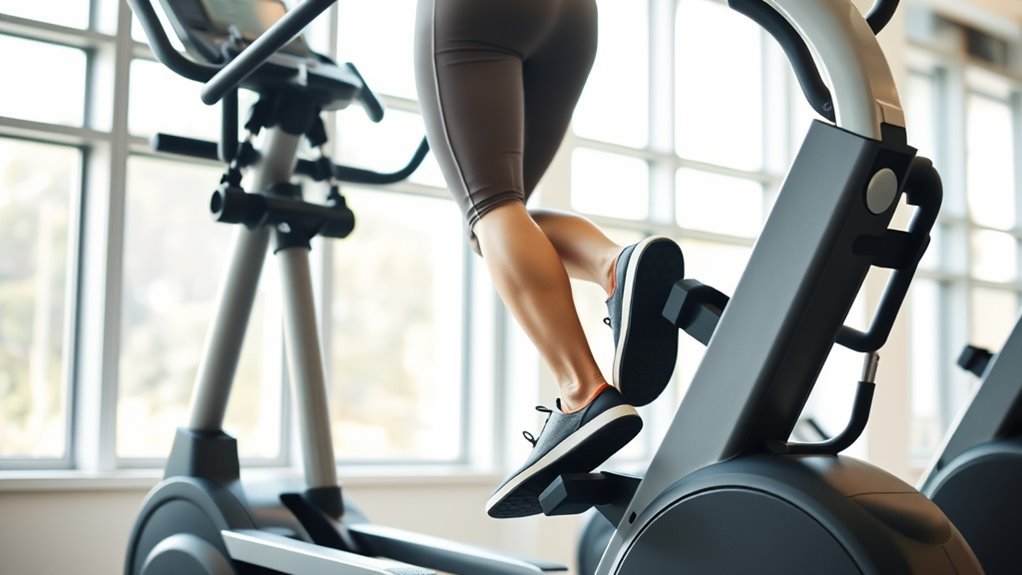
When picking an elliptical, you’ll want to contemplate resistance levels that won’t strain your knees. Make sure the stride length matches your natural movement to avoid discomfort.
Also, look for good cushioning and support to protect your joints during workouts. That way, you can keep your knees happy while you exercise.
Machine Resistance Levels
Although increasing resistance can boost your workout intensity, choosing the right machine resistance level is essential to protect your knees. You want a setting that challenges you without causing strain or discomfort.
Start with a low to moderate resistance, especially if you’re recovering from an injury or new to elliptical training. Pay close attention to how your knees feel during and after your workout.
If you notice any pain or stiffness, reduce the resistance immediately. Gradually increase resistance as your strength and endurance improve, but avoid sudden jumps that overload your joints.
Stride Length Importance
Adjusting resistance levels helps protect your knees, but choosing an elliptical with the right stride length can make an even bigger difference in your joint comfort. If the stride length is too short, your movement will feel cramped, putting extra strain on your knees.
Conversely, a stride that’s too long can overstretch your legs, causing discomfort or injury. Ideally, select an elliptical with an adjustable stride length or one that matches your natural walking or running stride. This alignment minimizes unnecessary stress on your knee joints and promotes a fluid, natural motion.
Before buying or using a machine, test different stride lengths to find what feels most comfortable and natural for you. Prioritizing proper stride length helps you exercise safely and keeps your knees healthy.
Cushioning and Support
Because your knees absorb much of the impact during exercise, choosing an elliptical with proper cushioning and support is essential to prevent discomfort and injury. Look for machines featuring shock-absorbing pedals or suspension systems that reduce joint stress.
A cushioned footpad lessens impact, helping your knees stay comfortable during longer workouts. Also, verify the pedals offer stability to prevent unwanted foot movement, which can strain your knees.
Adjustable pedal positions allow you to find the most natural alignment for your legs, further supporting knee health. Before buying, test the elliptical to confirm it feels comfortable and supportive.
Prioritizing cushioning and support in your elliptical will help you exercise safely, keeping your knees healthy and pain-free. It’s definitely worth taking the time to find the right fit!
Proper Foot Placement and Posture on the Elliptical
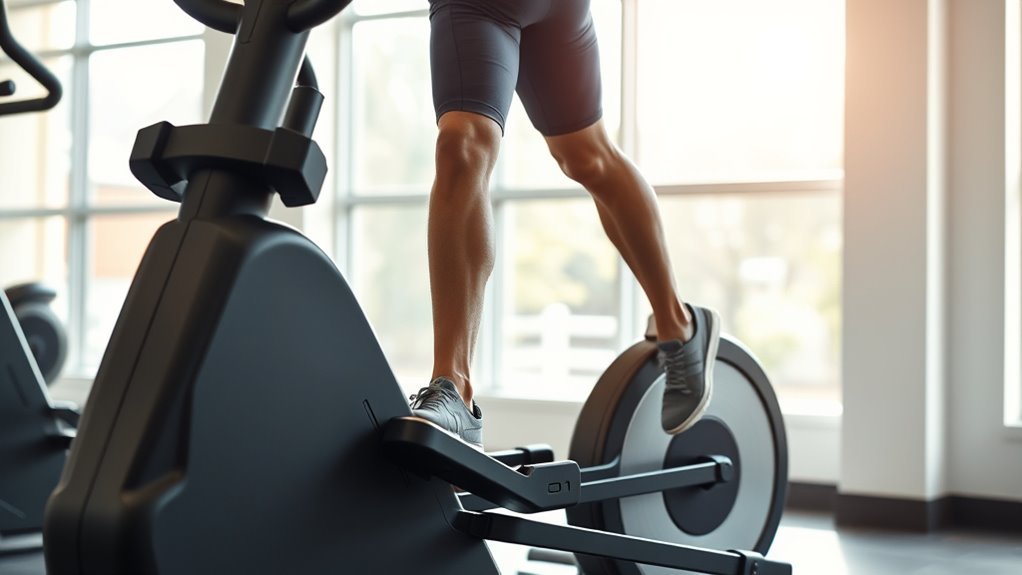
To get the most out of your elliptical workout, make sure you align your feet properly on the pedals. Keep your posture upright to avoid unnecessary strain, and engage your core muscles to support your balance.
These simple adjustments will help you exercise safely and effectively. Trust me, a little attention to your form goes a long way!
Align Feet Correctly
While using an elliptical trainer, you’ll want to position your feet firmly in the center of each pedal to maintain balance and control. Keep your feet flat and avoid letting your heels lift, which can strain your knees and reduce stability.
Make sure your toes point straight ahead, aligning with the direction of the pedals to prevent twisting your knees. If your machine has adjustable pedals, set them to a comfortable width that matches your natural stance.
This alignment helps distribute your body weight evenly, reducing pressure on your joints. By focusing on proper foot placement, you’ll protect your knees and enhance your workout effectiveness.
Maintain Upright Posture
How you hold your posture on the elliptical can make all the difference in your workout’s effectiveness and safety. To protect your knees and get the most benefit, stand tall and keep your spine neutral.
Avoid leaning forward or slouching. That can strain your lower back and misalign your knees. Make sure your feet stay flat on the pedals, distributing your weight evenly.
Focus on these key points:
- Keep your shoulders relaxed and back, not hunched.
- Align your hips over your feet to prevent unnecessary stress.
- Avoid locking your knees; maintain a slight bend throughout motion.
Engage Core Muscles
Although it might seem natural to focus solely on your legs when using an elliptical, engaging your core muscles plays an essential role in maintaining balance and enhancing stability.
To do this, tighten your abdominal muscles gently as you move, keeping your spine aligned and avoiding leaning on the handlebars too much.
Proper foot placement is equally important—position your feet flat and centered on the pedals to distribute weight evenly. This stance supports your knees and prevents unnecessary strain.
By activating your core and maintaining correct posture, you’ll improve your overall control on the machine, reduce the risk of injury, and get a more effective workout.
Adjusting Resistance and Incline to Protect Your Knees
Because your knees bear much of the impact during elliptical workouts, you’ll want to carefully adjust the resistance and incline settings to avoid strain. Start with a low resistance level that feels comfortable, then gradually increase it as your strength improves.
Avoid setting the incline too high, which can place extra pressure on your knees. Instead, find a moderate incline that challenges you without causing discomfort. Pay attention to how your knees respond and make adjustments accordingly.
Here are key tips to protect your knees:
- Keep resistance at a manageable level to prevent overloading knee joints.
- Use a gentle incline to engage muscles without adding excessive stress.
- Increase settings gradually, listening to your body’s signals.
Incorporating Warm-Up and Cool-Down Routines
Adjusting your resistance and incline settings helps protect your knees, but preparing your body before and after your workout plays a big role too. Start with a 5-10 minute warm-up at a low resistance and comfortable pace to increase blood flow and gently loosen your knee joints. This reduces stiffness and primes your muscles for exercise.
After your session, spend another 5-10 minutes cooling down by gradually decreasing intensity. Follow this with gentle stretches targeting your quadriceps, hamstrings, and calves to maintain flexibility and prevent tightness that could strain your knees.
Incorporating consistent warm-up and cool-down routines enhances your elliptical workouts’ safety and effectiveness. It really helps you protect your knees and enjoy long-term joint health.
Monitoring Your Form to Prevent Knee Strain
When you pay close attention to your form on the elliptical, you can considerably reduce the risk of knee strain. Keep your knees aligned with your feet to avoid unnecessary twisting.
Maintain a slight bend in your knees throughout the workout to prevent locking them, which puts extra pressure on the joint. Also, engage your core to stabilize your body and distribute the effort evenly.
Here are key points to monitor:
- Keep your knees tracking over your toes, avoiding inward or outward collapse.
- Maintain a controlled, smooth pedaling motion without jerky movements.
- Avoid leaning heavily on the handles; use them lightly for balance, not support.
Recommended Workout Duration and Frequency
Though you might be enthusiastic to maximize your workouts, it’s important to balance duration and frequency to avoid overtraining on the elliptical. Aim for sessions lasting 20 to 40 minutes, depending on your fitness level and how your knees feel.
Starting with shorter workouts allows your body to adapt without excessive strain. Try to work out three to five times per week, giving your knees time to recover between sessions.
Consistency is key, but rest days help prevent irritation and injury. Listen to your body and gradually increase time or intensity as you build strength.
Signs of Knee Discomfort and When to Seek Help
If you start feeling sharp pain, persistent swelling, or a grinding sensation in your knees during or after elliptical workouts, these are clear signs you should pause and reassess.
Ignoring these symptoms can worsen your condition and lead to long-term damage. Pay close attention to how your knees respond, and don’t push through pain.
Here are key signs to watch for:
- Sharp or stabbing pain that doesn’t improve with rest
- Swelling or warmth around the knee joint
- A feeling of instability or the knee giving way
If you notice any of these, it’s best to stop exercising and consult a healthcare professional.
Early intervention helps prevent serious injuries and keeps your knees healthy for the long run. So, don’t wait it out—take care of those knees!
Frequently Asked Questions
Can Elliptical Training Help Improve Knee Cartilage Health?
Yes, elliptical training can help improve knee cartilage health by providing low-impact exercise that promotes joint lubrication and strengthens surrounding muscles.
Just make sure you use proper form and avoid overdoing it to keep your knees safe. Taking it slow and steady really makes a difference.
Are Knee Braces Necessary When Using an Elliptical Trainer?
Picture your knees gliding smoothly like gears in a well-oiled machine. You don’t usually need knee braces on an elliptical.
But if you feel discomfort or instability, slipping one on can add extra support and peace of mind. It’s all about what feels right for you.
How Does Elliptical Training Compare to Cycling for Knee Safety?
Elliptical training is generally gentler on your knees than cycling because it reduces joint impact with smooth, low-impact motion.
However, cycling also offers low-impact benefits, so choose based on comfort and knee response during exercise.
It really depends on what feels best for you and how your knees react while working out.
Can I Use an Elliptical Trainer With Existing Mild Arthritis?
Yes, you can use an elliptical trainer with mild arthritis. Just start slowly, maintain proper form, and avoid overexertion.
Listen to your body, and if pain worsens, consult your doctor before continuing your workouts.
What Footwear Is Best for Elliptical Workouts to Protect Knees?
You should wear supportive, cushioned athletic shoes with good arch support and shock absorption. Avoid worn-out shoes, and choose ones that fit well to reduce knee strain during elliptical workouts.
This helps keep your joints protected and comfortable. Trust me, the right shoes make a big difference when you’re working out!
Conclusion
Using an elliptical trainer the right way can be a game-changer for your knees, almost like giving them a gentle, protective hug every time you work out. By choosing the right machine and maintaining proper posture, you set yourself up for success. Plus, listening to your body helps you avoid unnecessary strain.
You’ll keep knee strain at bay and enjoy pain-free movement when you pay attention to these details. Remember, consistency is key—warm-ups, cool-downs, and watching your form all matter. When you take care of your knees like this, they’ll feel stronger and more resilient than ever.
So, to use elliptical trainers for good knees safely, focus on proper technique and regular care. This approach not only protects your joints but also boosts your overall knee health, letting you move comfortably and confidently every day.