What Muscles Does an Elliptical Work Besides Your Glutes?
When you use an elliptical, you engage more than just your glutes. This popular cardio machine works a variety of muscles, making it a highly efficient full-body workout.
Your quads and hamstrings power your legs, while your calves stabilize your ankles for smooth pedaling.
Your core muscles stay tight, supporting balance and posture. Plus, your upper body—including biceps, triceps, shoulders, and back—gets a workout through handle movements.
Adjusting resistance and stride length shifts focus among these muscle groups. Keep exploring to uncover how to maximize your elliptical workout effectively.
Key Takeaways
- Elliptical machines engage quadriceps to extend the knees and power forward pedaling movements. These muscles really help you push through each stride.
- Hamstrings work to bend the knees and control backward pedal strokes during elliptical exercise. They balance out the motion and keep things smooth.
- Calf muscles stabilize ankles and help lift heels, contributing to smooth, continuous pedaling. Without them, your feet wouldn’t move as easily.
- Core muscles maintain balance and posture by isometrically contracting during elliptical workouts. This means your abs and lower back are working hard even if you don’t feel it.
- Upper body muscles, including biceps, triceps, shoulders, and back, activate through handle pushing and pulling motions. So, it’s a full-body workout, not just your legs!
Primary Leg Muscles Engaged on an Elliptical
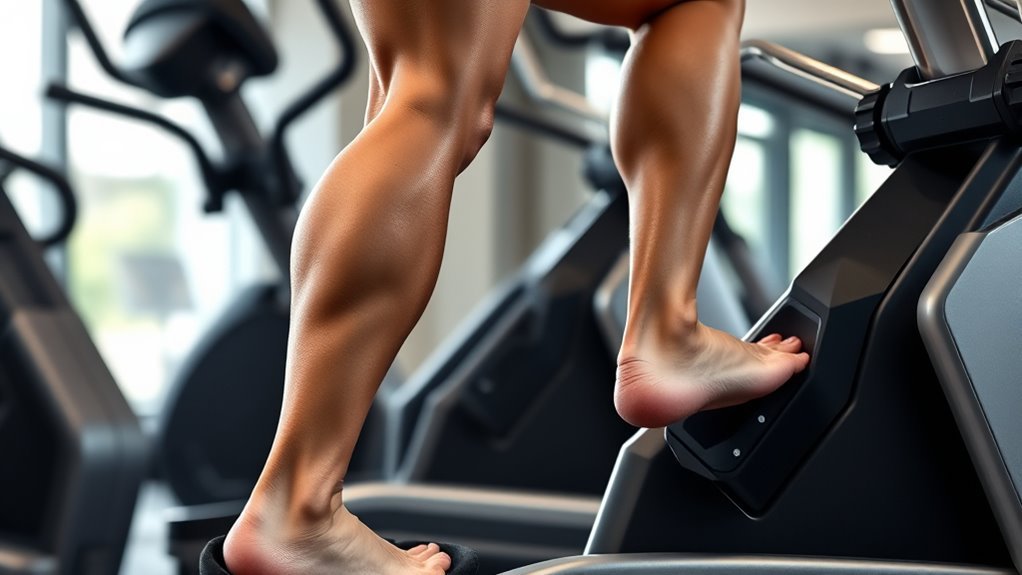
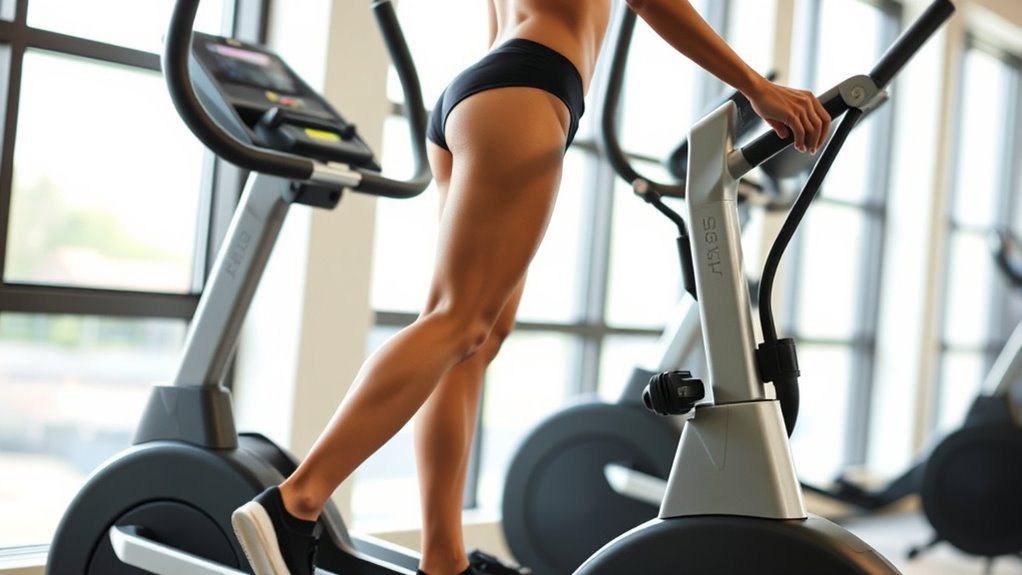
When you hop on an elliptical, you primarily engage four key leg muscles: the quadriceps, hamstrings, glutes, and calves. Your quadriceps work hard as they extend your knees during each pedal stroke, powering your forward motion.
The hamstrings complement this by bending your knees and controlling the movement as your feet move backward. Your glutes activate to stabilize your hips and provide strength for the push-off phase.
Meanwhile, your calves contract to lift your heels and maintain smooth pedaling. Together, these muscles create a balanced, low-impact workout that tones your legs while protecting your joints.
How the Core Muscles Benefit From Elliptical Workouts
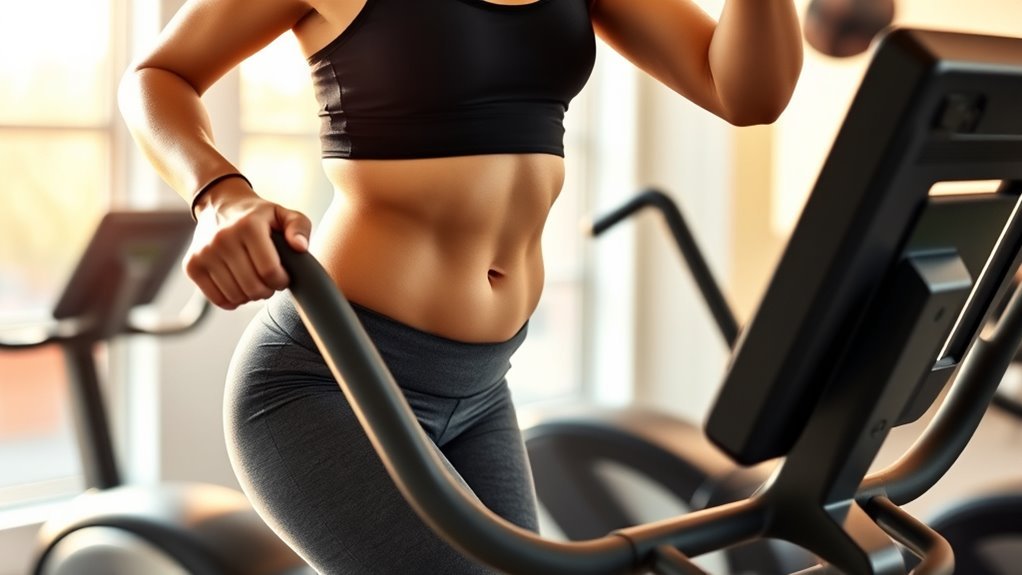
When you use the elliptical, your core muscles stay engaged to help maintain your balance and stability. This constant activation strengthens your abdominal and lower back muscles, supporting better posture.
As a result, you’ll notice improved overall stability both on and off the machine. Pretty cool, right? Your core gets a solid workout without you even realizing it!
Core Muscle Engagement
Although elliptical machines primarily target your legs, they also engage your core muscles to help stabilize your body throughout the workout. As you maintain an upright posture while moving, your abdominal and lower back muscles activate to keep your torso steady.
This continuous engagement strengthens your core over time, improving your overall posture and reducing the risk of back pain. You’ll notice that when you increase resistance or speed, your core works harder to control your movements.
Even without direct twisting or bending, your core muscles contract isometrically to support balance and alignment. So, while the elliptical mainly focuses on your lower body, it quietly provides an effective core workout, enhancing your stability and supporting your fitness goals.
Stability and Balance
Because elliptical workouts require you to maintain steady control over your movements, your core muscles play a crucial role in enhancing your stability and balance. As you pedal and glide, your abdominal and lower back muscles constantly engage to keep your torso upright and steady.
This continuous activation helps you develop better coordination and prevents wobbling or swaying during exercise. Over time, strengthening these core muscles improves your overall body control, making everyday activities easier and reducing your risk of falls or injuries.
Improved Posture Support
Strengthening your core on the elliptical doesn’t just help with balance—it also supports better posture throughout your day. As you engage your abdominal and lower back muscles to maintain stability during your workout, you’re training your body to hold itself upright more efficiently.
This enhanced core strength reduces slouching and minimizes strain on your spine. It makes everyday activities like sitting at a desk or carrying groceries easier and more comfortable.
When you work out on the elliptical, your core muscles help by:
- Stabilizing your torso to keep your spine aligned
- Supporting your lower back to prevent fatigue
- Encouraging an upright stance that translates to improved posture off the machine
Upper Body Muscle Activation With Elliptical Handles
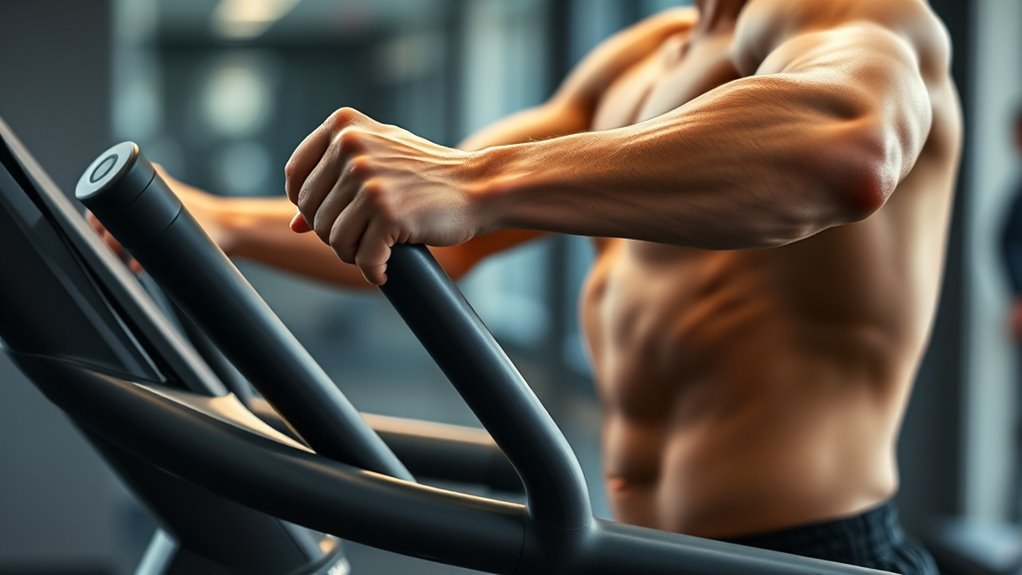
When you grip the elliptical handles, your upper body gets more than just a passive workout. The handles engage your biceps and triceps as you push and pull, providing resistance that tones these muscles effectively.
Your shoulders also get activated, especially the deltoids, as you move the handles in a controlled, rhythmic motion. Additionally, gripping the handles engages your forearm muscles, improving your grip strength over time.
Moving the handles rhythmically activates your deltoids and strengthens your forearms for better grip over time.
Your chest and upper back muscles, including the pectorals and rhomboids, work to stabilize your movements and maintain posture. This coordinated effort not only boosts your upper body strength but also enhances overall muscle balance.
Using the handles turns your elliptical session into a full-body workout, maximizing efficiency and calorie burn. It’s a great way to get more out of your exercise time!
The Role of Calves During Elliptical Exercise
When you use an elliptical, your calves play a key role in pushing and stabilizing each step. Activating these muscles not only improves your balance but also boosts lower leg strength and endurance.
Understanding how your calves work can help you get the most benefit from your workout. So, it’s pretty important to pay attention to them while you exercise.
Calf Muscle Engagement
Although the elliptical primarily targets larger muscle groups, your calves play a crucial role in maintaining smooth, controlled movements. As you pedal, your calf muscles contract and relax continuously, helping stabilize your ankles and propel your feet through the elliptical’s natural motion.
This engagement keeps your stride fluid and efficient.
When you focus on calf muscle engagement, you:
- Activate your gastrocnemius and soleus muscles to support ankle flexion and extension.
- Enhance balance by stabilizing your lower leg during each elliptical stride.
- Coordinate with your quads and hamstrings to create seamless, rhythmic pedaling.
Benefits of Calf Activation
Why does activating your calves during elliptical workouts matter? Engaging your calf muscles enhances your overall lower-leg strength and stability. When you push through the elliptical pedals using your calves, you improve ankle mobility and balance, which helps prevent injuries.
Plus, strong calves support better endurance, allowing you to maintain a steady pace longer without fatigue. Activating these muscles also promotes better circulation, reducing muscle soreness post-workout.
By consciously working your calves, you ensure a more efficient stride and maximize calorie burn. This targeted engagement complements your glutes and hamstrings, creating a balanced lower-body workout.
Glute Variations and Their Involvement Beyond the Basics
Since the elliptical engages your glutes in various ways, it’s important to understand how different parts of these muscles activate beyond the basic workout. Your glutes consist mainly of the gluteus maximus, medius, and minimus, each contributing uniquely during elliptical motion.
Elliptical workouts uniquely activate all parts of your glutes, enhancing strength and sculpting beyond basic exercise.
By recognizing their involvement, you can better appreciate how your workout sculpts and strengthens your lower body.
- Gluteus Maximus: Powers hip extension as you push down and back on the pedals.
- Gluteus Medius: Stabilizes your hips side-to-side, especially when you maintain balance on one leg.
- Gluteus Minimus: Assists with hip rotation and abduction, subtly engaged through the elliptical’s elliptical movement.
Understanding these variations helps you maximize your elliptical sessions and target your glutes more effectively. It’s pretty cool how such a simple machine can work your muscles in different ways, right?
How to Adjust Resistance for Targeting Different Muscle Groups
When you adjust the resistance on your elliptical, you directly influence which muscle groups get the most work. Increasing resistance forces your legs to push harder, engaging your quads, hamstrings, and calves more intensely.
This added challenge also activates your glutes to maintain power. Lower resistance lets you focus on endurance and cardiovascular benefits with less muscle strain.
To target your upper body, increase resistance while using the handles; this ramps up work for your biceps, triceps, and shoulders. If you want to emphasize your core, maintain moderate resistance and focus on a stable, controlled motion.
Doing this helps engage your abs and lower back. By varying resistance thoughtfully, you can tailor your workout to strengthen specific muscle groups and meet your fitness goals efficiently.
The Impact of Elliptical Stride Length on Muscle Engagement
Adjusting resistance on your elliptical shapes which muscles you work, but stride length also plays a significant role in muscle engagement. When you change the stride length, you alter how your legs move and which muscles get activated.
A longer stride recruits more from your hamstrings and glutes, giving your lower body a deeper workout. On the other hand, a shorter stride focuses more on your quads and calves, making it easier but less intense.
Consider these effects when adjusting stride length:
- Longer stride: boosts glute and hamstring activation
- Shorter stride: emphasizes quads and calves
- Medium stride: balances muscle engagement evenly
Combining Elliptical Training With Strength Exercises for Balanced Muscle Development
To achieve balanced muscle development, you should combine elliptical training with targeted strength exercises. While the elliptical effectively works your glutes, quads, hamstrings, and calves, adding strength exercises helps address muscles the elliptical might miss or underwork, like your upper back, chest, and core.
Incorporate moves such as planks, push-ups, and rows to build upper-body strength and improve posture. Don’t forget exercises like lunges and deadlifts to enhance lower-body power and stability.
Frequently Asked Questions
Can Elliptical Workouts Improve Flexibility or Just Muscle Strength?
Elliptical workouts mainly improve muscle strength and cardiovascular fitness, but they don’t directly boost flexibility.
To increase flexibility, you’ll need to add stretching or yoga alongside your elliptical routine for the best results.
How Does Elliptical Training Affect Bone Density Over Time?
Elliptical training helps maintain and slightly improve bone density by providing low-impact weight-bearing exercise. While it’s gentler than running, it still stimulates bone health.
This is especially true if you stay consistent and combine it with strength training. So, it’s a great option if you want to protect your bones without the high impact.
Are There Specific Elliptical Settings for Injury Rehabilitation?
Think of elliptical settings like tuning a guitar after a fall—adjust resistance and incline gently to avoid strain.
For injury rehab, you’ll want low resistance and a slow pace. Gradually increase these as your strength and mobility improve.
Does Elliptical Exercise Help With Cardiovascular Endurance Effectively?
Yes, elliptical exercise helps boost your cardiovascular endurance effectively. It keeps your heart rate elevated and improves lung capacity.
Plus, it offers low-impact, continuous movement. That makes it a great choice for building stamina and heart health.
Can Elliptical Use Contribute to Weight Loss Without Diet Changes?
Want to burn calories without changing your diet? Yes, elliptical use can help with weight loss by boosting calorie burn, but combining exercise with healthy eating speeds results.
Conclusion
When you step onto the elliptical, you’re not just giving your glutes a gentle nudge—you’re inviting your entire body to join the dance. Your legs, core, calves, and even your arms quietly celebrate the effort, growing stronger with every stride.
By tweaking resistance and stride, you reveal new levels of muscle engagement, making each session a graceful journey toward balanced strength and vitality.
Keep moving, and let your body thank you in its own powerful way. Using the elliptical works multiple muscles beyond your glutes, including quads, hamstrings, calves, and your core. It’s a fantastic full-body workout that builds endurance and tones muscles while being gentle on your joints. So, next time you hop on the elliptical, remember—it’s not just cardio; it’s a total body workout that helps you become stronger, fitter, and more balanced.