Are RDLS Better With Dumbbells or Barbell?
If you’re wondering whether Romanian deadlifts (RDLs) are better with dumbbells or a barbell, it really depends on what you want to achieve.
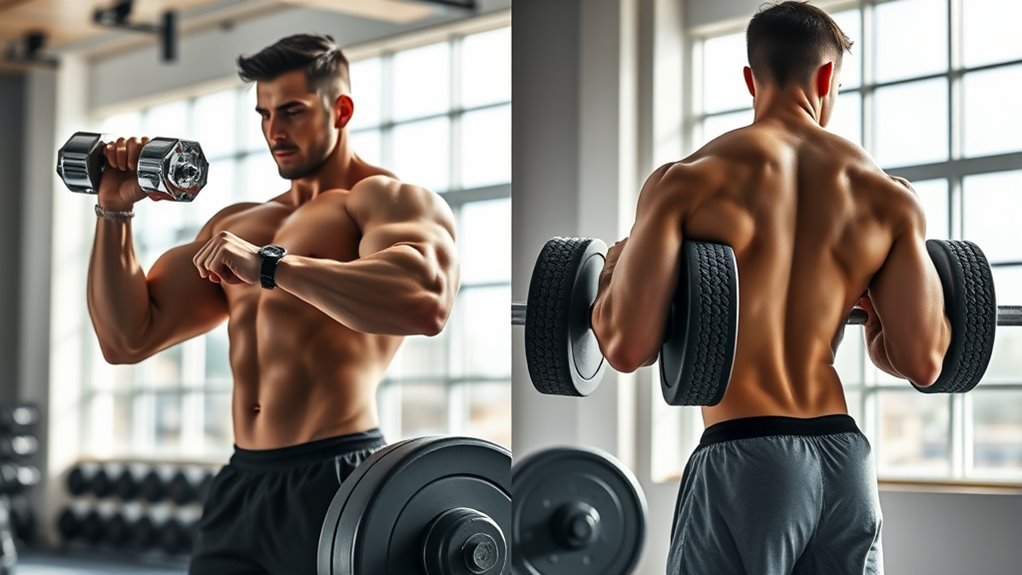
Dumbbells are great for improving muscle balance and control because they engage more stabilizer muscles. Plus, they allow a greater range of motion, which can help fix muscle imbalances.
On the other hand, barbells let you lift heavier weights more safely and with better stability. This makes them ideal for building strength faster, especially in your primary muscles.
So, if your goal is to increase overall strength, barbells might be the way to go.
Ultimately, your choice comes down to your fitness goals and experience level. Keep experimenting to find which option suits your training style and needs best.
Both have their perks, so mix it up and see what feels right for you!
Key Takeaways
- Dumbbells increase stabilizer muscle activation and improve balance through independent arm movement in Romanian Deadlifts (RDLs). This can really help with coordination and control.
- Barbells provide greater stability and allow heavier loads. That’s great for building maximal strength and progressive overload in RDLs.
- Dumbbells also let you have a greater range of motion and a deeper hip hinge. This enhances muscle stretch and activation during RDLs.
- Barbells promote symmetrical form and control with a fixed grip. Plus, they reduce the stabilization demand during RDLs.
- So, choose dumbbells if you’re aiming to improve balance, coordination, and muscle symmetry. But pick barbells when you want to maximize strength and handle heavier lifting in RDLs.
Benefits of Romanian Deadlifts With Dumbbells
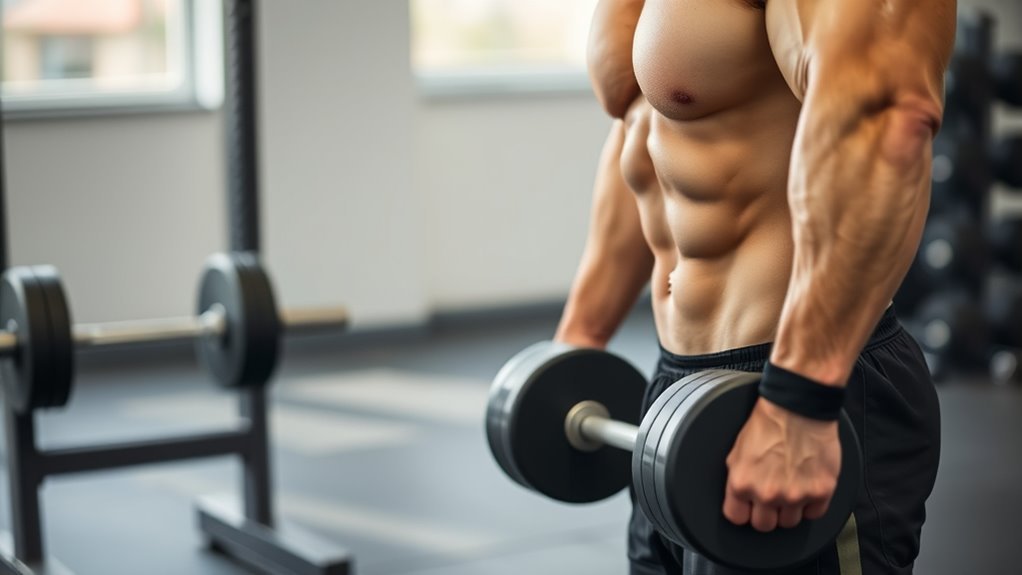
Why choose dumbbells for Romanian deadlifts? Dumbbells offer you greater freedom of movement, letting your body find a natural path that feels comfortable. You can adjust your grip and stance more easily, which helps reduce the risk of imbalances and overuse injuries.
Dumbbells also engage your stabilizing muscles more effectively since each side works independently, improving overall muscle coordination. They’re perfect if you don’t have a spotter or access to a barbell, making your workout more versatile and accessible.
Plus, dumbbells allow you to focus on form and control, enhancing your mind-muscle connection. When you use dumbbells, you can also target smaller muscle groups that might be overlooked with a barbell, leading to more balanced strength development.
Advantages of Using a Barbell for RDLs
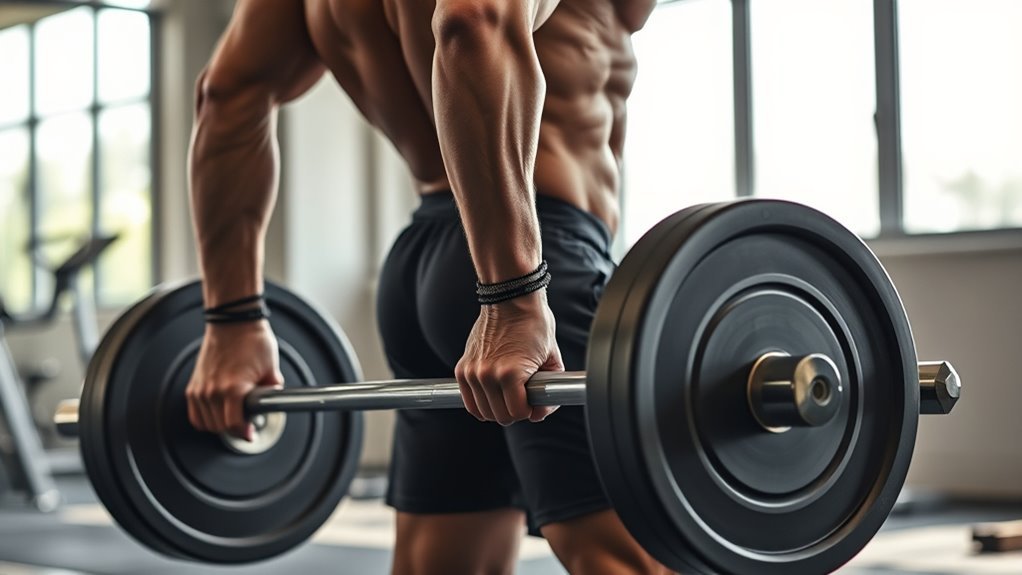
When you use a barbell for RDLs, you get better stability and balance during the lift. It also lets you handle heavier loads, making it easier to progress over time.
These benefits can help you build strength more efficiently. Plus, using a barbell feels pretty natural once you get the hang of it. So, it’s a solid choice if you want to challenge yourself and see real gains.
Stability and Balance Benefits
Although both dumbbells and barbells challenge your muscles, using a barbell for Romanian Deadlifts (RDLs) offers superior stability and balance. The barbell’s fixed grip and symmetrical load distribution help you maintain a steady center of gravity, reducing wobbling and uneven movement.
This stability lets you focus on form and control, minimizing the risk of injury. You’ll find it easier to keep your spine neutral and hips aligned throughout the lift.
| Stability Factor | Barbell Benefit |
|---|---|
| Grip | Fixed and secure |
| Load Distribution | Even across both sides |
| Center of Gravity | More balanced |
| Body Alignment | Easier to maintain |
| Movement Control | Enhanced precision |
This makes barbells the go-to for improving your balance during RDLs.
Load Capacity and Progression
Beyond stability and balance, barbells let you handle heavier loads during Romanian Deadlifts, which makes them perfect for progression. When you use a barbell, you can add weight in smaller, controlled steps. This helps you gradually build strength and muscle over time.
This precise load management is harder to achieve with dumbbells, especially if you don’t have access to a wide range of weights. Plus, barbells distribute weight evenly across your body, reducing the risk of muscle imbalances as you increase the load.
If your goal is to push your limits and track consistent progress, barbells give you the structure and capacity to do so effectively. So, if you want to steadily increase your strength, barbells are definitely the way to go.
Impact on Muscle Activation and Strength Gains
Since your goal is to maximize muscle activation and strength gains, choosing between dumbbells and a barbell for Romanian Deadlifts (RDLS) plays an essential role. Dumbbells force each side of your body to work independently, increasing stabilizer muscle engagement.
Barbells allow you to lift heavier loads, promoting greater overall strength development.
Here’s how each impacts your gains:
- Dumbbells enhance muscle symmetry by targeting imbalances.
- Barbells enable progressive overload, indispensable for strength.
- Dumbbells activate more stabilizers due to increased control demands.
- Barbells primarily focus on prime movers like hamstrings and glutes with heavier weights.
Ultimately, your choice should align with whether you prioritize muscle balance and control or maximum strength and load capacity.
Differences in Range of Motion and Form
When you perform Romanian Deadlifts with dumbbells versus a barbell, you’ll notice distinct differences in range of motion and form that affect how your muscles engage. Dumbbells allow for a greater range of motion since each arm moves independently, letting you hinge deeper at the hips and maintain a more natural wrist and shoulder position.
This can improve muscle stretch and activation, especially in your hamstrings and glutes. On the other hand, a barbell restricts your hand placement and may limit your hip hinge depth slightly but encourages a more symmetrical form.
With a barbell, you’ll keep your hands fixed at a set width, which helps stabilize the load and can lead to better overall control during heavier lifts. Both tools demand proper form but vary in movement freedom.
Considerations for Beginners vs. Advanced Lifters
Choosing between dumbbells and a barbell for Romanian Deadlifts affects not only your form and range of motion but also how you should approach the exercise based on your experience level.
If you’re a beginner, dumbbells can help you focus on balance and control without overwhelming your grip or posture. Advanced lifters might prefer barbells to handle heavier loads and challenge strength progression.
Consider these points:
- Dumbbells allow independent arm movement, helping you correct imbalances early.
- Barbells offer greater loading potential, ideal for building maximal strength.
- Beginners benefit from lighter weight and easier setup with dumbbells.
- Advanced lifters need barbell stability to push limits safely and efficiently.
Equipment Availability and Workout Convenience
Although both dumbbells and barbells have their benefits, your access to equipment can greatly influence which option fits best into your routine. If you train at a busy gym, barbells might be harder to find during peak hours, making dumbbells a more convenient choice.
Dumbbells are often more accessible and allow you to quickly switch weights, saving time between sets. On the other hand, if you have a home gym, investing in a barbell setup might make sense since it takes up less space than a full dumbbell rack.
Also, barbells are easier to load with heavier weights, which can be convenient as you progress. Consider your environment and how much time you want to spend waiting or adjusting equipment when deciding between the two.
Injury Prevention and Joint Stress
Because your joints bear the brunt of each repetition, you need to contemplate how dumbbells and barbells affect injury risk and joint stress during RDLs.
Dumbbells allow for a more natural arm and shoulder position, reducing strain on your wrists and elbows. Barbells, however, keep your grip fixed, which can increase stress if your form slips.
Consider these points for injury prevention:
- Dumbbells let each side move independently, helping correct imbalances and reduce joint overload.
- Barbells promote a uniform load but can lock your wrists in a less comfortable position.
- Dumbbells require more stabilization, engaging smaller muscles and protecting joints.
- Barbells offer heavier loading but demand strict form to avoid joint strain.
Choose wisely to keep your joints safe and pain-free.
How to Choose Between Dumbbells and Barbell for Your Goals
When deciding between dumbbells and a barbell, consider how each affects muscle activation and your need for stability and control. Dumbbells often demand more balance, while barbells let you handle heavier weights more easily.
Think about your progression goals and which tool fits your training style best. It’s all about what works for you and keeps you motivated.
Muscle Activation Differences
How do dumbbells and barbells differ in the way they activate your muscles? When you use dumbbells, each side of your body works independently. This forces your stabilizers and smaller muscles to engage more.
Barbells, on the other hand, allow you to lift heavier loads. But they often rely more on your larger muscle groups.
Consider these differences:
- Dumbbells increase activation in stabilizing muscles for better balance.
- Barbells target prime movers like glutes and hamstrings more directly.
- Dumbbells encourage symmetrical muscle development by addressing imbalances.
- Barbells enable progressive overload easier due to heavier weight capacity.
Choosing between them depends on what you want. Do you want to emphasize muscle balance and control? Or focus on maximizing strength in the primary muscles?
Stability and Control
Although both dumbbells and barbells build strength, your choice should hinge on the level of stability and control you want during your workout. Dumbbells force you to stabilize each side independently, engaging more stabilizer muscles and improving balance.
This makes them ideal if you want to develop coordination and correct muscle imbalances. On the other hand, barbells offer more stability because your hands are fixed on a single bar.
This allows you to control heavier weights more easily and focus on lifting efficiently without worrying about balance. If you prefer a controlled movement with less emphasis on stabilization, the barbell might suit you better.
Ultimately, consider how much you want to challenge your stability and control to align your choice with your training goals.
Weight Progression Options
Since progressive overload is key to building strength, choosing between dumbbells and barbells depends largely on how you plan to increase your weights over time. Dumbbells offer smaller weight increments, allowing you to fine-tune your progression, while barbells often require larger jumps.
Consider these options:
- Dumbbells let you add 1-2.5 lbs per hand, ideal for gradual strength gains.
- Barbells usually increase in 5 lb plates, pushing you to lift heavier more quickly.
- Dumbbells challenge your stabilizer muscles differently on each side, aiding balanced growth.
- Barbells provide a stable load, helping you focus on maximal strength with consistent weight.
Frequently Asked Questions
Can Romanian Deadlifts Improve Posture?
Yes, Romanian deadlifts can improve your posture by strengthening your hamstrings, glutes, and lower back. They’ll help you maintain a healthier spine alignment and reduce slouching.
This is especially true when you focus on proper form. Keeping good technique makes all the difference in getting those posture benefits.
How Often Should I Perform Romanian Deadlifts Weekly?
You don’t want to turn into a Romanian deadlift machine, so aim for 2-3 times weekly with rest days.
This way, your muscles recover while you avoid walking like a robot in a workout frenzy.
Are Romanian Deadlifts Effective for Weight Loss?
Yes, Romanian deadlifts are effective for weight loss because they engage multiple muscle groups, boost your metabolism, and burn calories.
When you work several muscles at once, your body works harder, which means more calories burned.
Combine them with a proper diet and cardio for the best fat-burning results.
Trust me, it’s all about pairing strength moves like these with good eating habits and some cardio to really see the difference.
What Warm-Up Is Best Before Doing RDLS?
You should warm up with dynamic stretches like leg swings, hip circles, and bodyweight good mornings. These moves get your muscles ready and your joints moving smoothly.
Also, perform light sets of Romanian deadlifts with minimal weight to activate your hamstrings and glutes before your main workout. This helps prime your body so you can lift safely and effectively.
Can I Do Romanian Deadlifts With Resistance Bands?
Yes, you can do Romanian deadlifts with resistance bands. They provide constant tension throughout the movement, helping you build strength and flexibility.
Just make certain the band is securely anchored and you maintain proper form to avoid injury. It’s a great way to mix up your routine and challenge your muscles differently.
Conclusion
Choosing between dumbbells and a barbell for your Romanian Deadlifts is like picking the right paintbrush for your masterpiece. Dumbbells offer freedom and subtle control, letting you sculpt each muscle with precision. Meanwhile, barbells provide the solid foundation needed for building raw strength.
It really depends on your body’s canvas—your goals and experience. Dumbbells can help improve balance and target muscles individually, while barbells are great for lifting heavier weights and increasing overall power.
Whichever you choose, consistency is key. Sticking with either dumbbells or a barbell in your Romanian Deadlifts will help you build strength, improve muscle tone, and prevent injury. So listen to your body, pick the tool that feels right, and watch your progress paint a stronger, healthier you.