
How to Do Calf Raises With Dumbbells in 3 Easy Steps
To do calf raises with dumbbells, first pick weights that challenge you but don’t compromise your balance. Stand tall with your feet hip-width apart, holding the dumbbells by your sides.
This simple exercise targets your calves effectively and can be done anywhere with just a pair of dumbbells.
Next, lift your heels as high as you can, pausing briefly at the top to really feel your calves working. Then, slowly lower your heels back down with control. Keep your core engaged throughout the movement to maintain stability and maximize the benefits.
Keep going at a steady pace, and you’ll soon notice stronger, more defined calves.
With practice, you’ll discover ways to maximize your gains safely and effectively, making calf raises with dumbbells a great addition to your fitness routine.
Key Takeaways
- Hold a dumbbell in each hand with arms at your sides, standing tall on a stable, flat surface.
- Rise onto the balls of your feet by lifting your heels as high as possible, pausing briefly at the top.
- Lower your heels slowly back to the ground while maintaining balance and controlled movement.
- Keep your core engaged and avoid leaning forward or backward throughout the exercise.
- Breathe steadily, exhaling as you lift and inhaling as you lower your heels.
Preparing for Dumbbell Calf Raises

Before you begin dumbbell calf raises, make sure you’ve chosen the right dumbbells for your strength level. Pick weights that challenge you without compromising your balance or form.
Select dumbbells that challenge your strength while maintaining proper balance and form.
Next, find a sturdy surface or step to stand on, ensuring it won’t slip during your exercise. Wear supportive shoes to protect your feet and provide stability.
Check your posture by standing tall with your feet hip-width apart, shoulders back, and core engaged. Hold a dumbbell in each hand at your sides, letting your arms hang naturally.
Take a moment to warm up your calves with light stretches or a brief walk to increase blood flow. These preparations set you up for a safe and effective workout.
Executing the Calf Raise Movement
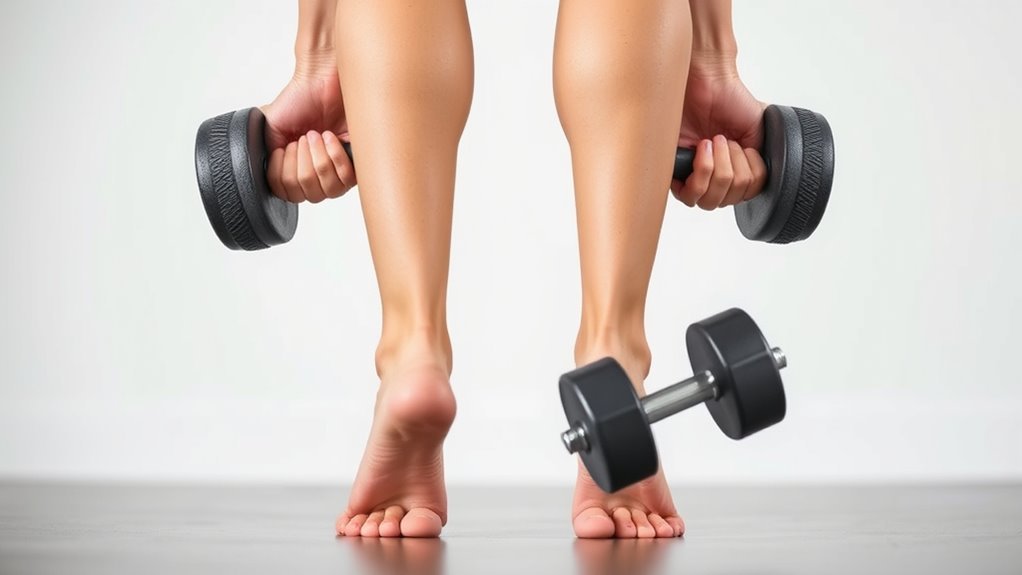
When you’re ready to begin, stand tall with your feet hip-width apart and hold a dumbbell firmly in each hand at your sides. Slowly rise onto the balls of your feet by lifting your heels as high as you can, engaging your calf muscles fully.
Pause briefly at the top to maximize muscle contraction. Then, lower your heels back down in a controlled manner until your feet are flat on the ground.
Keep your core engaged and avoid leaning forward or backward during the movement. Maintain steady breathing—inhale as you lower your heels and exhale as you lift.
Repeat this motion smoothly for the desired number of reps, focusing on form to get the most out of each calf raise.
Tips for Maximizing Your Calf Raise Workout

To get the most from your calf raise workout, focus on controlled movements and proper form throughout each repetition. Slow, steady lifts help engage your muscles fully. Don’t rush; pause at the top to maximize contraction.
Vary your foot position—point toes in, out, or straight—to target different calf muscles. Gradually increase dumbbell weight to build strength over time. Finally, stretch your calves after each session to improve flexibility and reduce soreness.
| Tip | Why It Helps | How to Apply |
|---|---|---|
| Controlled Movement | Enhances muscle engagement | Lift slowly, hold top position |
| Foot Position | Targets different muscles | Rotate toes in/out/straight |
| Progressive Overload | Builds strength gradually | Increase dumbbell weight weekly |
| Stretching | Prevents tightness | Stretch calves post-workout |
Frequently Asked Questions
Can Calf Raises With Dumbbells Help Reduce Shin Splints?
Yes, calf raises with dumbbells can help reduce shin splints by strengthening your calf muscles. This, in turn, improves ankle stability and enhances lower leg endurance.
All of these benefits work together to ease the stress on your shins during activities like running or jumping. So, incorporating calf raises into your routine can really make a difference.
How Often Should I Do Calf Raises for Best Results?
Think of your calves as engines—fuel them three times a week with 3 sets of 12-15 reps.
This steady rhythm builds strength without burning out, letting your muscles grow and support every stride you take.
Are Dumbbell Calf Raises Safe for People With Knee Pain?
Dumbbell calf raises can be safe if you keep your knees slightly bent and avoid locking them. This helps reduce strain on your knees while you exercise.
However, you should definitely consult your doctor or physical therapist first. They can make sure it’s appropriate for your specific knee condition and guide you on how to do it safely.
What Is the Difference Between Seated and Standing Calf Raises?
Standing calf raises target both the gastrocnemius and soleus muscles since your knees are straight. Seated calf raises focus more on the soleus because your knees are bent.
You’ll feel the difference in muscle engagement. It’s pretty interesting how a small change in position can shift the focus, right?
Can Calf Raises Improve My Running Speed or Jump Height?
Think of your calves as springs; yes, calf raises can boost your running speed and jump height by strengthening these muscles.
They improve explosive power and endurance, helping you push off the ground with more force and efficiency.
Conclusion
Who knew something as simple as standing on your toes could be a secret weapon for stronger calves? With just a pair of dumbbells and three easy steps, you’re set to turn those stubborn calves into muscle machines.
So next time you skip calf raises because they seem too basic, remember: sometimes the simplest moves pack the biggest punch. Now, get lifting—your calves will thank you, even if your ego doesn’t at first!
Incorporating dumbbell calf raises into your workout routine is an effective way to build strength and definition in your lower legs. These three easy steps make it accessible for everyone, whether you’re a beginner or looking to add more intensity. Consistency is key, and with a little effort, those calf muscles will become more toned and powerful. So grab your dumbbells, follow the steps, and watch your calves transform!