
How Many Calories Does the Elliptical Burn in 30 Minutes?
You can burn between 210 and 360 calories in 30 minutes on an elliptical, depending on your weight and workout intensity.
Heavier individuals and those pushing harder with higher resistance or speed tend to burn more.
Using both your arms and legs increases calorie output, and adding interval bursts can boost results further.
If you want to learn how resistance, incline, and workout tracking can ramp up your calorie burn even more, keep exploring the details.
Key Takeaways
- A 30-minute elliptical workout burns approximately 210-360 calories, depending on body weight and workout intensity.
- The harder you push with resistance and speed, the more calories you’ll burn during your session.
- Using both your arms and legs on the elliptical really helps engage more muscles, which means even more calorie burn.
- Try interval training—mixing bursts of high intensity with easier periods—to maximize how many calories you burn.
- Compared to other cardio machines, the elliptical holds its own by offering a low-impact, full-body workout that’s great for burning calories.
Factors Influencing Calorie Burn on an Elliptical
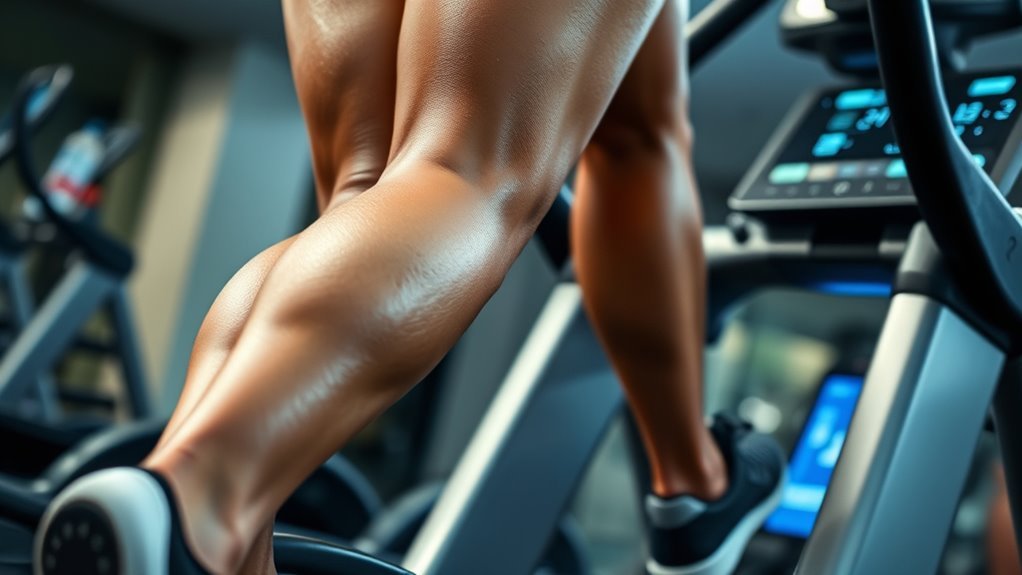
Although the elliptical machine provides a great workout, the number of calories you burn in 30 minutes depends on several factors. First, your workout intensity plays a big role—pushing harder increases calorie burn. Your resistance and speed settings directly influence how much energy you expend.
Second, your fitness level matters; if you’re more conditioned, you might burn fewer calories at the same effort compared to when you started. Third, your muscle engagement changes calorie output—using both your arms and legs simultaneously will torch more calories than focusing on your legs alone.
Finally, your body composition and metabolism also affect calorie burn, though you’ll explore weight and intensity details later. By adjusting your effort and settings, you control how effective your elliptical session is.
Average Calories Burned by Weight and Intensity

Your body weight plays a big role in how many calories you burn on an elliptical. The heavier you are, the more energy you’ll use during your workout.
Plus, increasing your workout intensity can considerably boost the calories you burn in just 30 minutes. It’s a simple way to get more out of your exercise without spending extra time.
Calories by Body Weight
Since calorie burn varies by individual, knowing how your body weight influences the elliptical workout can help you set realistic goals. Heavier individuals tend to burn more calories because their bodies require more energy to move.
Here’s a quick guide showing approximate calories burned during 30 minutes on an elliptical, based on different weights at a moderate effort:
| Body Weight (lbs) | Calories Burned (30 mins) | Approximate Intensity |
|---|---|---|
| 120 | 210 | Moderate |
| 150 | 260 | Moderate |
| 180 | 310 | Moderate |
| 210 | 360 | Moderate |
| 240 | 410 | Moderate |
Use this as a baseline to tailor your workout goals effectively. It’s a helpful way to see what you might expect and adjust your efforts accordingly.
Impact of Workout Intensity
When you push yourself harder on the elliptical, you’ll burn greatly more calories—even if your workout duration stays the same. For example, a 155-pound person burns about 335 calories in 30 minutes at a moderate pace, but that number jumps to roughly 400 calories when working out vigorously.
Similarly, someone weighing 185 pounds can burn around 400 calories at moderate intensity, increasing to nearly 480 calories at a high intensity. The difference comes down to how much effort you put in: higher resistance levels and faster strides demand more energy from your muscles.
How Workout Intensity Affects Calorie Expenditure

Although the elliptical machine offers a consistent workout, the number of calories you burn depends largely on how intensely you exercise. When you increase your effort—by pushing harder, increasing resistance, or speeding up—you force your body to work harder, which burns more calories.
Higher intensity workouts elevate your heart rate, boost metabolism, and engage more muscle groups, all contributing to greater calorie expenditure. On the other hand, a leisurely pace with low resistance will burn fewer calories, even if you’re on the elliptical for 30 minutes.
To maximize your calorie burn, you can incorporate intervals of high intensity followed by recovery periods. Remember, the harder you challenge yourself, the more energy you’ll expend during and even after your workout.
Comparing Elliptical Calorie Burn to Other Cardio Machines
If you want to understand how the elliptical stacks up against other cardio machines regarding calorie burn, it helps to compare their typical energy expenditures. The elliptical often offers a moderate to high calorie burn, but how does it fare against treadmills or stationary bikes?
Your results will depend on intensity and duration, but here’s a general comparison:
- Treadmill running can burn 300-450 calories in 30 minutes, often more if you add incline.
- Stationary biking usually burns 200-300 calories, depending on speed and resistance.
- Elliptical workouts typically range from 250-400 calories, with added arm movement boosting totals.
Knowing these figures can help you choose the right machine to meet your calorie-burning goals efficiently.
Benefits of Using the Elliptical for Weight Loss
Because the elliptical combines cardio and strength training, it offers an efficient way to burn calories and build muscle simultaneously, which can accelerate weight loss. You engage both your upper and lower body, increasing overall calorie expenditure compared to some other machines.
Plus, the low-impact nature of the elliptical protects your joints, making it easier to work out consistently without injury. And this consistency? It’s really key to shedding pounds over time.
Using the elliptical also improves your cardiovascular health, which boosts your metabolism and helps your body burn fat more effectively. By incorporating interval training on the elliptical, you can keep your workouts challenging and prevent plateaus.
Tips to Maximize Calorie Burn on the Elliptical
To burn more calories on the elliptical, start by adjusting the resistance levels to challenge your muscles. You can also boost your workout intensity by incorporating interval training, alternating between high and low effort.
These simple changes will help you get the most out of your session. Give it a try and see how much more effective your workout can be!
Adjust Resistance Levels
While using the elliptical, adjusting the resistance levels plays a crucial role in boosting your calorie burn. Increasing resistance forces your muscles to work harder, which means you burn more calories in the same amount of time.
Don’t just stick to one setting—vary it to challenge different muscle groups and keep your workout effective. Here’s how to optimize resistance:
- Gradually increase resistance as your fitness improves to avoid plateaus.
- Use higher resistance for short bursts to engage strength and endurance.
- Combine moderate resistance with a steady pace for longer, fat-burning sessions.
Incorporate Interval Training
Although steady-state workouts have their benefits, incorporating interval training on the elliptical can substantially boost your calorie burn. You alternate between high-intensity bursts and moderate recovery periods, challenging your body and increasing metabolism.
This method not only burns more calories during your workout but also keeps your body burning fat afterward. Try mixing 30 seconds of sprinting with 90 seconds of easy pedaling.
| Interval Type | Duration | Intensity Level |
|---|---|---|
| Warm-up | 5 minutes | Low |
| High-intensity | 30 seconds | High |
| Recovery | 90 seconds | Moderate |
| Repeat Cycles | 8 rounds | Vary |
| Cool-down | 5 minutes | Low |
Incorporate intervals regularly to maximize efficiency and calorie burn on your elliptical workouts. It’s a smart way to get more out of your exercise time. Give it a try and feel the difference!
Role of Resistance and Incline Settings in Calorie Burn
Adjusting the resistance and incline settings on your elliptical directly impacts how many calories you burn during your workout. When you increase resistance, your muscles work harder, which boosts calorie expenditure.
Increasing resistance on your elliptical makes your muscles work harder, leading to higher calorie burn.
Similarly, raising the incline engages different muscle groups, especially your glutes and hamstrings, intensifying your effort. To maximize calorie burn, consider these tips:
- Higher resistance forces your body to exert more power, increasing overall energy use.
- Steeper incline targets lower body muscles more effectively, enhancing workout intensity.
- Combining resistance and incline creates a balanced, full-body challenge that elevates your heart rate and calorie burn.
Tracking Your Elliptical Workout for Better Results
To get the most out of your elliptical sessions, you need to track your workouts consistently. Monitoring your time, resistance, and calories burned helps you adjust your routine for better results.
Use apps or the machine’s built-in display to log your data and spot progress trends. Tracking also keeps you motivated by showing measurable improvements.
| Session Date | Resistance Level | Calories Burned |
|---|---|---|
| April 1 | 5 | 250 |
| April 3 | 7 | 275 |
| April 5 | 6 | 260 |
Frequently Asked Questions
Can Using the Elliptical Improve Cardiovascular Health?
Yes, using the elliptical can improve your cardiovascular health by increasing your heart rate and boosting circulation. You’ll build endurance, strengthen your heart, and enhance lung capacity while enjoying a low-impact, full-body workout.
It’s a great way to get your blood pumping without putting too much stress on your joints. Plus, because it works both your upper and lower body, you get a more balanced workout that helps keep your heart healthy.
Is the Elliptical Suitable for People With Joint Pain?
Worried about joint pain? The elliptical’s low-impact motion protects your joints while giving you a good workout.
You’ll enjoy pain-free exercise, making it a perfect option if you want to stay active without discomfort. It’s a great way to keep moving without stressing your body too much.
How Often Should I Use the Elliptical for Best Results?
You should use the elliptical 3-5 times a week for best results, mixing intensity levels. Consistency helps build endurance and burns calories effectively while minimizing joint stress.
Always listen to your body and rest as needed. It’s all about finding a balance that works for you!
Can Elliptical Workouts Help Build Muscle?
Yes, elliptical workouts can help build muscle, especially in your legs, glutes, and core. You’ll engage multiple muscle groups, which is great for overall toning.
But if you’re looking for significant muscle growth, it’s a good idea to combine your elliptical sessions with strength training exercises. That way, you get the best of both worlds!
What Are Common Mistakes to Avoid on the Elliptical?
Don’t grip the handles like they’re glued to your hands! You’ll want to avoid leaning too much, slouching, or using too little resistance.
Keep your posture straight and challenge yourself for the best workout results. It really makes a difference when you stay mindful of these things!
Conclusion
Think of your elliptical workout as a key that unlocks your body’s potential to burn calories efficiently. By adjusting intensity, resistance, and incline, you can turn a simple 30-minute session into a powerful calorie-burning engine.
Remember, consistency and tracking your progress are your best allies. With each stride, you’re not just moving—you’re crafting a healthier, stronger you.
So, step on confidently and make every minute count. The elliptical can burn a significant number of calories in just 30 minutes, depending on how hard you push yourself. Whether your goal is weight loss or improved fitness, this machine is a great tool to help you reach it. Keep at it, and watch your calorie burn soar!