How to Calculate Many Steps in 30 Minutes on the Treadmill
To calculate how many steps you take in 30 minutes on a treadmill, start by measuring your stride length. Walk a known distance and divide that distance by the number of steps you took. This gives you an accurate stride length to work with.
Next, multiply your total walking distance in 30 minutes by the number of steps per foot. This helps estimate your total step count during the treadmill session.
You can also use the treadmill’s built-in step counter or wearable fitness devices for more accuracy.
Try adjusting your speed and posture to see how your step counts vary. Keep going, and you’ll discover helpful tips for boosting your step totals effectively while walking or running on the treadmill.
Key Takeaways
- Measure your stride length by walking a known distance and counting your steps. This helps estimate how many steps you take per distance on the treadmill.
- Next, calculate the total distance you’ll walk in 30 minutes. Just multiply the treadmill speed in mph by 0.5 hours. Then, convert that distance into feet or meters to make it easier to work with.
- After that, divide the total distance by your stride length. This will give you an estimate of the total steps you take during your 30-minute treadmill session.
- You can also use the treadmill’s built-in step counter or wear a device to track your steps in real time. These tools help you get a more accurate count while you work out.
- If you want to increase your total steps, try walking faster or adding an incline. Both can change your stride length and step rate, helping you maximize steps in those 30 minutes.
Understanding Step Count Basics
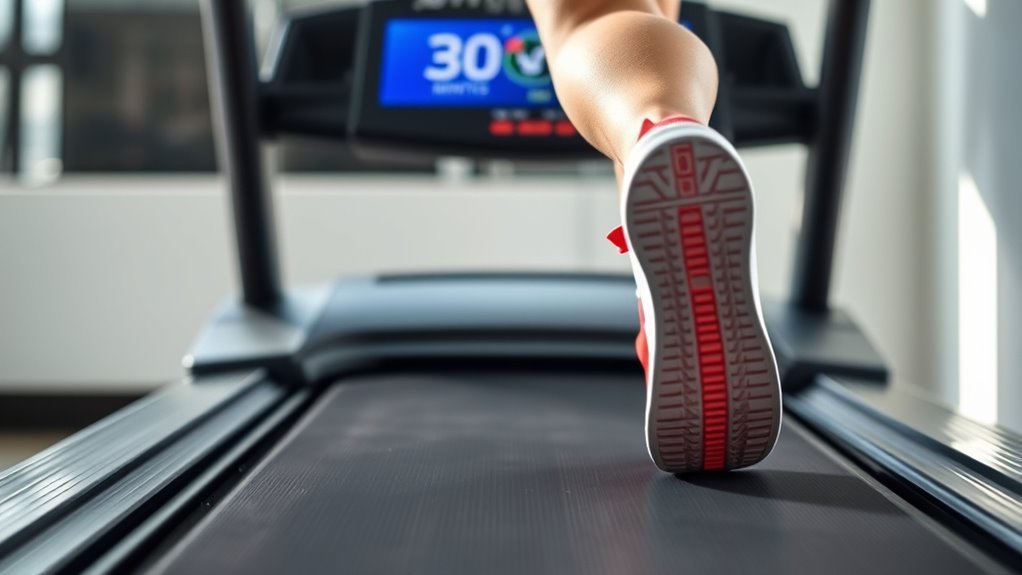
How do you accurately track your steps on a treadmill? First, understand that each step you take counts as one, regardless of pace. Your step count depends on your walking or running speed, stride length, and treadmill settings.
Many treadmills have built-in step counters, but they might not always be precise. You can also use a pedometer or smartphone app to track steps, which often rely on motion sensors for accuracy.
To get a reliable step count, you should know your average stride length—typically around 2.1 to 2.5 feet for walking. Multiply the number of strides by two to estimate total steps.
Factors Affecting Steps on a Treadmill
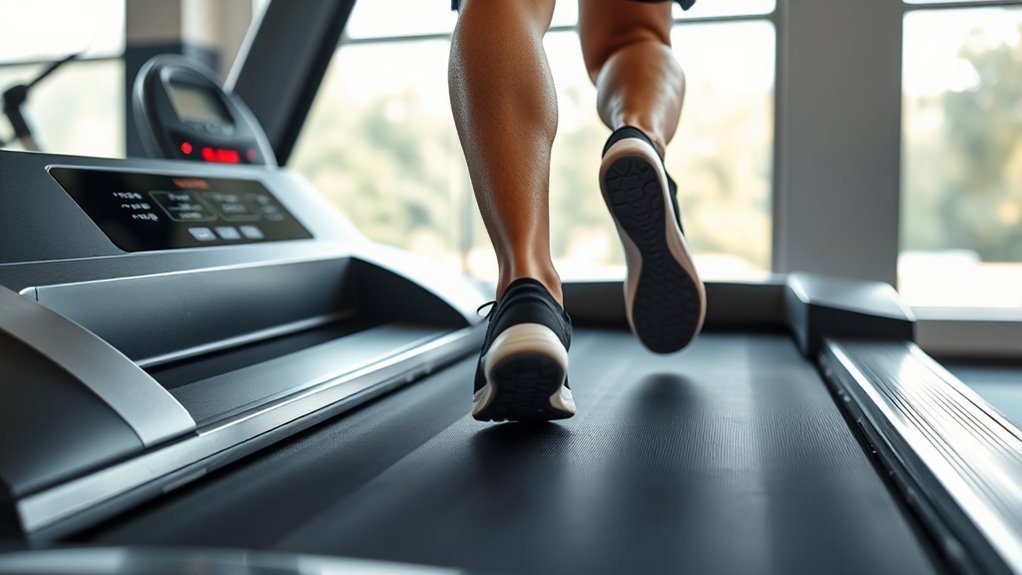
Although you might expect your step count to stay consistent, several factors can influence the number of steps you take on a treadmill. Your walking or running speed plays a big role—faster speeds typically mean longer strides but fewer steps per minute.
Step count on a treadmill varies with speed—faster pace means longer strides but fewer steps per minute.
Your posture and how you move can also affect step count; for example, shorter, quicker steps increase the total steps taken. The treadmill’s incline influences effort and stride length, which in turn alters step frequency.
Additionally, the treadmill’s belt size and calibration might impact how steps are recorded. Finally, fatigue can cause you to naturally adjust your stride, changing your step count over time.
Understanding these factors helps you better estimate and track your treadmill steps accurately.
Measuring Your Stride Length
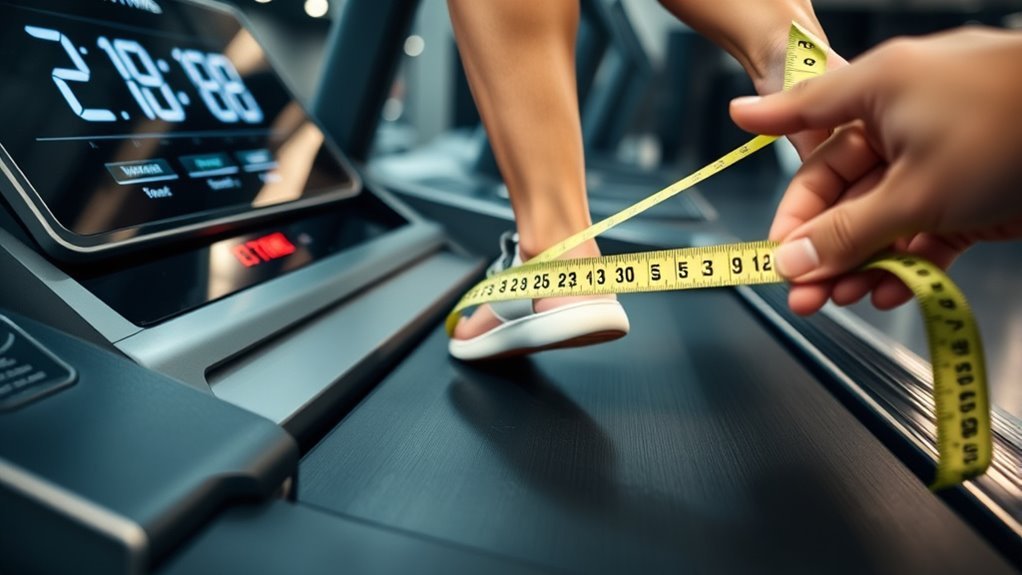
To accurately calculate your steps, you need to measure your stride length first. Your step distance can change based on factors like your height, walking speed, and treadmill incline.
Knowing these details helps you get a precise step count during your 30-minute workout. It’s pretty handy to have this info so you can track your progress better.
Determining Your Step Distance
Wondering how far each step actually takes you on the treadmill? To figure out your step distance, start by measuring your stride length — that’s the distance between two consecutive steps of the same foot.
You can do this by marking a straight path, walking naturally for several steps, and then measuring the total distance covered. After that, divide that distance by the number of steps you took to find your average step length.
On the treadmill, your step distance is pretty close to this stride length, although the treadmill speed might slightly affect it. Knowing your step distance helps you translate steps into the actual distance you’ve walked or run.
This gives you a clearer picture of your workout. Once you have this number, you can easily calculate how many steps you take in 30 minutes based on your treadmill speed.
Factors Influencing Stride Length
Since your stride length can vary depending on several factors, it’s important to understand what influences it before measuring. Your height, pace, and treadmill incline all play a role in how far your foot travels with each step.
Recognizing these elements helps you get a more accurate stride length, making your step count calculations reliable.
| Factor | Effect on Stride Length | How It Feels to You |
|---|---|---|
| Height | Taller = longer stride | Effortless, natural |
| Pace | Faster pace = longer stride | Energizing, fluid |
| Treadmill Incline | Uphill = shorter stride | Challenging, focused |
Keep these in mind, and you’ll measure your stride length with confidence.
Calculating Steps Based on Walking Speed
You can estimate your steps by linking your walking speed to your step length. Knowing how many steps you take per minute at a certain speed helps you calculate total steps in 30 minutes.
Let’s break down how to use these numbers for an accurate step count. It’s easier than it sounds once you get the hang of it!
Step Length and Speed
Although calculating steps on a treadmill might seem straightforward, understanding how your step length and walking speed interact is essential for accuracy.
Your step length is the distance covered with each step, and it changes depending on how fast you walk. When you increase speed, your steps usually get longer, so you cover more ground with fewer steps.
Conversely, walking slower shortens your step length, increasing the total number of steps for the same distance.
To calculate steps accurately, first estimate your average step length at your chosen speed. Then, multiply the total distance you’ll walk in 30 minutes by this step length.
This approach helps you better predict your step count, making your treadmill workouts more precise and tailored to your pace.
Steps Per Minute Calculation
Understanding your step length helps set the stage for calculating how many steps you take each minute on the treadmill. To find your steps per minute, first determine your walking speed in miles per hour (mph) or kilometers per hour (km/h).
Then, convert that speed into distance covered per minute. For example, if you walk at 3 mph, you cover 0.05 miles per minute (3 miles ÷ 60 minutes).
Next, convert that distance to feet (1 mile = 5,280 feet), so 0.05 miles equals 264 feet per minute. Finally, divide the total feet per minute by your step length in feet.
If your step length is 2.5 feet, divide 264 by 2.5, which equals about 106 steps per minute. This calculation helps you track your treadmill steps accurately.
Using the Treadmill’s Built-In Step Counter
When you step onto the treadmill, its built-in step counter immediately starts tracking your movements. It gives you a quick and accurate measure of your steps taken during your workout. This feature uses sensors to count each footfall, so you don’t have to estimate or manually track your steps.
To use it effectively, make sure the treadmill’s display is set to show step count. Then, just start your workout as usual. You can check the step count periodically or wait until the end of your 30-minute session to see your total steps.
Keep in mind, the counter is designed for walking or running on the treadmill belt. So, it might not register steps if you stop or step off. This built-in tool makes step tracking simple—no extra devices needed!
Estimating Steps for Different Workout Intensities
While the treadmill’s built-in step counter gives you an exact number during your workout, estimating steps based on your workout intensity can help you plan and adjust your exercise routine more effectively. Different intensities require different step rates, so knowing these can guide your goals.
- Light Intensity (Walking 2-3 mph): Expect about 2,400-3,000 steps in 30 minutes.
- Moderate Intensity (Brisk Walking 3.5-4 mph): Aim for roughly 3,500-4,200 steps.
- High Intensity (Jogging 5-6 mph): You’ll hit around 4,800-5,400 steps.
- Very High Intensity (Running 6+ mph): Count on 5,700+ steps.
Tracking Progress With Wearable Devices
Since tracking your treadmill steps manually can be tedious, wearable devices offer a convenient way to monitor your progress in real time. These gadgets use sensors to count steps accurately and provide insights like calories burned and distance covered.
Many also sync with smartphone apps, helping you analyze trends and set goals. Choosing a device that fits your needs and budget guarantees you stay motivated and informed throughout your workout.
| Device | Key Features | Battery Life |
|---|---|---|
| Fitbit Charge | Step count, heart rate | Up to 7 days |
| Garmin Vivosmart | GPS, activity tracking | Up to 5 days |
| Apple Watch | Multi-sport tracking | About 18 hours |
| Xiaomi Mi Band | Affordable, step count | Up to 14 days |
| Samsung Galaxy Fit | Lightweight, notifications | Up to 7 days |
Tips to Increase Your Step Count in 30 Minutes
Boosting your step count in just 30 minutes requires a strategic approach that combines pace, posture, and consistency.
You can maximize your treadmill workout by focusing on these key tips:
- Increase Your Speed Gradually – Start at a comfortable pace and steadily increase your speed to challenge yourself without sacrificing form.
- Maintain an Upright Posture – Keep your back straight and shoulders relaxed to optimize stride length and efficiency.
- Use Arm Movement – Swing your arms naturally to help propel your body forward and boost your step frequency.
- Incorporate Incline Intervals – Adding incline challenges your muscles more and encourages quicker steps, raising your overall count.
Follow these strategies to make every minute count and see your step numbers climb reliably within your half-hour treadmill sessions.
Frequently Asked Questions
Can Treadmill Steps Help Improve Cardiovascular Health?
Yes, treadmill steps can boost your cardiovascular health by increasing your heart rate and improving circulation. Regular walking or running strengthens your heart, lowers blood pressure, and enhances endurance.
This helps you stay fitter and healthier over time. So, it’s a simple but effective way to care for your heart!
How Does Incline Affect Calorie Burn Versus Step Count?
Incline increases calorie burn by making your muscles work harder, even if your step count stays the same or drops.
Are Treadmill Steps Equivalent to Outdoor Walking Steps?
Treadmill steps aren’t exactly the same as outdoor walking steps because the treadmill belt assists your movement. You’ll feel less wind resistance and terrain changes, so your muscle engagement and step mechanics can differ slightly.
That means when you’re walking outside, your body works a bit harder to stabilize and propel you forward. On a treadmill, the consistent surface and pace can make your steps feel a little easier. So, while the step count might be similar, the experience and effort can vary.
What’s the Best Time of Day to Maximize Step Count?
You’ll maximize your step count by exercising in the morning when your energy is highest and distractions are fewer. Your body’s fresh, so you’ll maintain a faster pace longer, boosting the total steps you rack up.
Plus, mornings tend to be quieter, which means fewer interruptions and a better chance to focus on your walk or run. It’s like giving yourself the best possible start to the day—with a healthy boost right from the get-go.
Can Step Counting on a Treadmill Assist With Weight Loss?
Yes, step counting on a treadmill can assist with weight loss because it helps you track activity, stay motivated, and increase your calorie burn.
Consistently hitting step goals boosts your overall fitness and fat-burning efforts.
Conclusion
Now that you know how to measure and boost your steps on the treadmill, why settle for just walking when you can make every minute count? By understanding your stride, speed, and using your treadmill’s features or wearables, you’re set to track progress like a pro.
So, are you ready to turn 30 minutes into a powerful step-counting session that gets you closer to your fitness goals? Lace up and step it up! Remember, calculating many steps in 30 minutes on the treadmill isn’t just about moving—it’s about moving smart. Keep your pace steady, adjust your stride, and use the treadmill’s settings to maximize your step count.
With these tips, you can make the most out of each treadmill workout. Whether you’re aiming for weight loss, improved stamina, or just hitting a daily step goal, consistently tracking your steps will keep you motivated. So get walking, stay consistent, and watch your fitness journey progress step by step!