

How You Can Train for a Marathon on a Treadmill
You can train for a marathon on a treadmill by setting your pace to match your target race speed and using a 1% incline to simulate outdoor running. This helps mimic the effort of running outside, even when you’re indoors.
Gradually building endurance with longer steady runs is key, while mixing in interval training can boost your speed.
Incorporate hill workouts by increasing the incline to strengthen your legs and improve stamina.
Tracking your progress regularly allows you to adjust the intensity of your workouts as needed. Stay motivated by varying your routines and listening to your body to avoid injury.
Keep exploring different techniques to fine-tune your training plan effectively and get marathon-ready right at home.
Key Takeaways
– Set treadmill speed to your target marathon pace and use a 1% incline to simulate outdoor running conditions.
This little incline really helps mimic the feel of running outside. It makes your training more realistic and effective.
– Gradually increase long run distances on the treadmill to build endurance safely and consistently.
Taking it step by step keeps you from overdoing it and reduces injury risk. Plus, it helps you stay motivated as you see progress.
– Incorporate interval training with high-intensity sprints and recovery jogs to improve speed and cardiovascular fitness.
Mixing up your workouts keeps things interesting and pushes your limits in a smart way.
– Simulate race conditions by adjusting pace, incline, and hydration breaks during treadmill workouts.
This prepares you mentally and physically for what race day will feel like. Don’t forget to practice your hydration strategy too.
– Monitor your progress and listen to your body, modifying workouts to prevent injury and maintain motivation.
If something feels off, it’s okay to dial back or switch things up. Staying in tune with your body is key to marathon success.
Benefits of Treadmill Training for Marathon Preparation

Although running outdoors offers fresh air and varied scenery, training on a treadmill provides unique benefits that can boost your marathon preparation. You gain full control over your pace, incline, and environment, allowing you to fine-tune workouts to match race demands precisely.
Treadmills reduce impact on your joints, which helps you train consistently with less risk of injury. You’re also not limited by weather or daylight, so you can stick to your schedule regardless of conditions outside.
Plus, treadmills often feature built-in programs and tracking tools that help monitor progress and motivate you. By combining these advantages, you create a reliable, efficient training routine that complements your outdoor runs and prepares you effectively for race day.
Setting Up Your Treadmill for Marathon Workouts
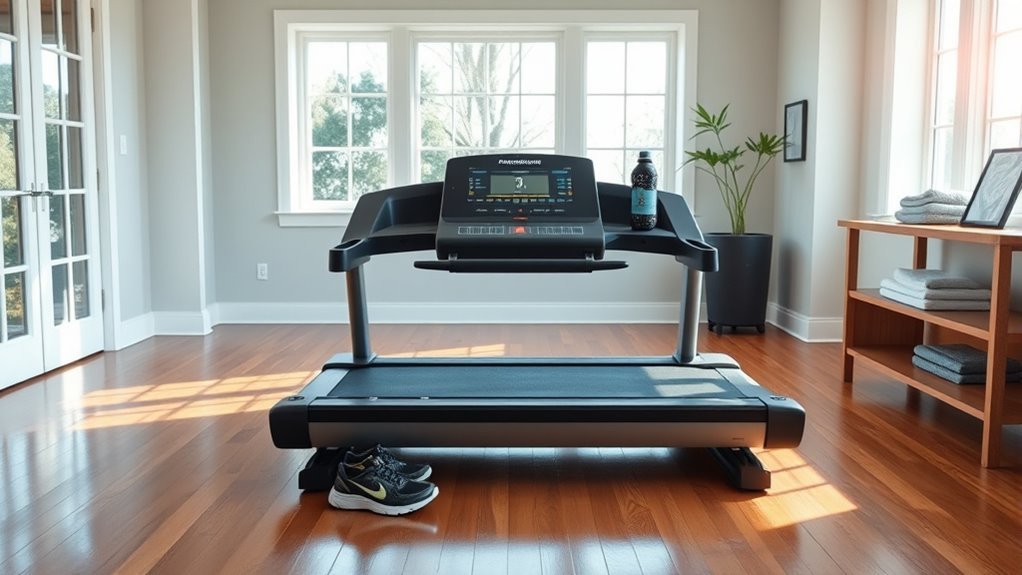
When you set up your treadmill for marathon workouts, adjusting the speed and incline to mimic race conditions is essential. Start by setting a base speed that matches your target marathon pace.
Then, add a 1% incline to simulate outdoor running resistance. Adjust settings progressively to match different segments of your race plan.
| Setting | Recommendation |
|---|---|
| Speed | Match marathon pace |
| Incline | 1% to simulate terrain |
| Warm-up | 5–10 minutes at low speed |
| Cool-down | 5 minutes at slow pace |
| Safety | Use emergency stop clip |
Building Endurance With Long Runs on the Treadmill

To build endurance on the treadmill, start by gradually increasing your long run distances each week. Keep a steady pace that challenges you without causing burnout.
This approach helps you adapt and prepares your body for marathon demands. Just take it step by step, and you’ll notice your stamina improving over time.
Gradual Distance Increase
As you prepare for your marathon, increasing your treadmill distance gradually helps your body adapt without risking injury. Start by adding small increments each week, allowing your muscles and joints to strengthen steadily.
Avoid sudden jumps in distance to prevent overuse injuries. Consistency is key—stick to your plan and listen to your body’s signals.
| Week | Target Distance (miles) |
|---|---|
| 1 | 3 |
| 2 | 4 |
| 3 | 5 |
| 4 | 6 |
This gradual increase builds endurance and confidence. Remember, it’s better to progress slowly than to push too hard and face setbacks.
Use these steady gains to prepare effectively for race day. You’ve got this!
Maintaining Steady Pace
How do you build true endurance on a treadmill? Maintaining a steady pace during your long runs is key. Start by selecting a speed you can comfortably sustain for the entire session without feeling overly fatigued.
Resist the urge to sprint or drastically change your speed; consistency helps your body adapt to prolonged effort. Use the treadmill’s display to monitor your pace, aiming to keep it stable throughout.
If you notice your pace dropping, slow down slightly to recover, then gradually return to your target speed. This controlled approach trains your cardiovascular system and muscles to endure distance.
Over time, you’ll find it easier to maintain this steady rhythm, which directly translates to improved marathon performance. Keep at it—you’ll get there!
Incorporating Interval Training to Boost Speed
Although steady-state runs build endurance, incorporating interval training on your treadmill can dramatically boost your speed and overall performance. Start by alternating between high-intensity sprints and recovery jogs or walks.
Boost speed and performance by mixing high-intensity sprints with recovery jogs or walks on your treadmill.
For example, sprint at 80-90% of your maximum effort for 30 seconds, then recover at a slow pace for one to two minutes. Repeat this cycle for 15-20 minutes. This approach pushes your cardiovascular system, improving both anaerobic and aerobic capacity.
Gradually increase sprint duration and intensity as your fitness improves. Interval training also enhances your running economy, helping you maintain faster paces with less effort.
Just be sure to warm up thoroughly before intervals and cool down afterward to prevent injury. Incorporate intervals two to three times weekly for best results.
Simulating Race Conditions Indoors
When you want to prepare effectively for race day, simulating race conditions indoors on your treadmill can make a significant difference. You can mimic pacing, hydration breaks, and even mental challenges.
Try running at your target race pace for specific intervals, then simulate quick water stops by pausing or slowing down briefly. This helps condition your body and mind for the real experience.
| Element | Indoor Simulation | Race Day Equivalent |
|---|---|---|
| Pacing | Use treadmill speed settings | Maintain consistent speed |
| Hydration Breaks | Slow down or pause briefly | Grab water at aid stations |
| Mental Focus | Visualize race environment | Stay focused amid crowds |
Using Incline Settings to Mimic Outdoor Terrain
You can adjust the incline on your treadmill to simulate the hills you’ll face outdoors. By varying the incline levels, you’ll build strength and endurance just like running on real terrain.
Incorporate hill workouts into your routine to prepare your legs for race day challenges. It’s a great way to get ready without leaving your home!
Adjusting Incline Levels
Since outdoor routes often include varied elevations, adjusting your treadmill’s incline is essential to replicate those conditions. By tweaking the incline, you engage different muscles and improve strength, endurance, and running efficiency.
Start with small inclines, around 1-2%, to simulate flat outdoor terrain. Then gradually increase to challenge yourself without overexertion.
Here’s a simple guide to incline settings and their outdoor equivalents:
| Incline Level | Terrain Type | Training Benefit |
|---|---|---|
| 0% | Flat road | Base endurance |
| 1-2% | Slight incline | Realistic outdoor feel |
| 3-5% | Moderate hills | Muscle strengthening |
Adjust incline based on your workout goals, and listen to your body to avoid injury while maximizing your treadmill marathon training.
Simulating Hill Workouts
Although treadmill running lacks natural hills, you can simulate challenging hill workouts by adjusting the incline settings strategically. Start by selecting a moderate incline, around 3-5%, to mimic gentle uphill stretches.
For steeper climbs, increase the incline to 6-10%, pushing your strength and endurance. Incorporate intervals where you alternate between flat running and elevated inclines to replicate varied outdoor terrain.
Aim for sessions that last 20-30 minutes, gradually increasing incline and duration over time. Remember to maintain good posture and shorten your stride slightly to handle the incline effectively.
Simulating hill workouts on a treadmill not only builds leg strength but also improves cardiovascular fitness. Plus, it prepares you for real marathon conditions without leaving your home gym.
Monitoring Your Progress and Adjusting Workouts
As you progress through your treadmill marathon training, tracking your performance becomes essential to guarantee steady improvement. Use a training log or app to record your speed, incline, distance, and how you feel after each session.
Regularly review this data to identify trends and areas for improvement. If your pace plateaus or you feel fatigued, it’s time to adjust your workouts.
Try incorporating interval training or increasing the incline to challenge your endurance. On the other hand, if you notice consistent soreness or declining performance, scale back intensity or add rest days.
Monitoring your progress helps you tailor your program effectively, preventing injury and burnout while pushing your limits. So, stay flexible and responsive to your body’s feedback to maximize your treadmill marathon training results.
Tips for Staying Motivated During Treadmill Training
Keeping your motivation high during treadmill training can be challenging, but you can overcome this by setting clear goals and varying your routine. Break your marathon plan into smaller milestones to celebrate progress regularly.
Switch up your workouts by adjusting speed, incline, or adding intervals to keep things interesting. Listening to energizing music or podcasts can distract you from the monotony and boost your mood.
Visualize finishing the marathon to remind yourself why you started. Also, consider tracking your achievements with apps or journals to see how far you’ve come.
Finally, find a virtual running community or training buddy for support and accountability. These strategies help you stay focused and committed, making treadmill training feel less like a chore and more like a step toward your marathon goal.
Frequently Asked Questions
What Shoes Are Best for Treadmill Marathon Training?
You’ll want lightweight, cushioned running shoes with good breathability and support. Look for models with shock absorption and a snug fit to prevent slipping.
Brands like Brooks, Asics, or Nike usually work great for treadmill training. They’ve got options that keep your feet comfortable and stable during long runs.
How Do I Prevent Boredom During Long Treadmill Runs?
Imagine a scenic trail unfolding before you—use music, podcasts, or virtual running apps to create that vibe.
Mix speed intervals, change inclines, and visualize your race day to keep boredom at bay and stay motivated.
Can Treadmill Training Reduce Injury Risk Compared to Outdoor Running?
Yes, treadmill training can reduce injury risk since you control speed, cushioning, and avoid uneven terrain.
You’ll experience less impact, but it’s smart to mix outdoor runs for varied muscle use and adaptability.
How Should I Hydrate During Indoor Treadmill Sessions?
You’ll want to keep your internal oasis well-stocked by sipping water steadily throughout your treadmill session.
Don’t wait for thirst to sneak up; regular, small drinks keep you balanced and performing at your best.
Is It Safe to Listen to Music or Podcasts While Running?
Yes, you can safely listen to music or podcasts while running, as long as you keep the volume low enough to stay aware of your surroundings and treadmill sounds.
It’ll keep you motivated and entertained during your workout. Just make sure you’re not too distracted and can still hear what’s going on around you.
Conclusion
Training for a marathon on a treadmill might not be the “scenic route,” but it’s a smart, controlled way to build your endurance and speed without the unpredictability of outdoor runs. By adjusting incline and pace, you’re crafting your own race day experience indoors.
Stay consistent, track your progress, and embrace the rhythm of the treadmill—it’s your quiet partner in crushing those marathon goals, rain or shine.
Using a treadmill to train lets you simulate hills and intervals, which are crucial for marathon prep. Plus, it offers a safe environment free from traffic or bad weather.
So, if you’re wondering how you can train for a marathon on a treadmill, remember that it’s all about steady effort and smart adjustments. Keep moving forward, and you’ll be ready to conquer race day with confidence!