How to Buy My Treadmill With My HSA
To buy your treadmill with HSA funds, you’ll need a doctor’s prescription showing it’s medically necessary for your condition. This step is important because the treadmill should address a specific health issue, not just general fitness goals.
Once you have the prescription, you can either use your HSA card to pay directly at the store or buy the treadmill yourself and then request reimbursement.
Just make sure to keep all receipts and documentation handy.
Keeping good records is key to avoiding any tax problems later on. Picking the right treadmill and understanding what qualifies for HSA spending can make the whole process smoother.
It’s definitely worth exploring your options and details carefully before making the purchase.
Key Takeaways
- Confirm your treadmill is medically necessary with a doctor’s prescription or letter of medical necessity before purchase.
- Verify the treadmill model meets medical-use criteria, focusing on stability, support, and safety features.
- Use your HSA card for direct payment or pay out of pocket and submit for reimbursement with required documentation.
- Keep all receipts, prescriptions, and product details to prove medical necessity and ensure IRS compliance.
- Consult your HSA provider for specific eligibility rules and documentation requirements to avoid tax penalties.
Understanding Eligible Medical Expenses for HSAs
Before you can use your Health Savings Account (HSA) to buy a treadmill, you need to understand which medical expenses qualify. HSAs cover costs directly related to medical care, including doctor visits, prescription medications, and certain medical equipment prescribed by a healthcare professional.
Generally, expenses must be primarily for medical treatment or prevention of a specific condition. Over-the-counter items, general wellness purchases, or fitness equipment without a prescription usually won’t qualify. You should keep receipts and documentation to prove the expense’s medical necessity.
Checking IRS guidelines and consulting your HSA provider can help you determine if your purchase fits the rules. Knowing what counts as an eligible expense ensures you use your HSA funds correctly and avoid unexpected tax penalties.
Criteria for Purchasing Exercise Equipment With HSA Funds
Although exercise equipment like treadmills can promote health, you can only use HSA funds to purchase them if they meet specific criteria set by the IRS.
First, the equipment must be medically necessary, prescribed by a healthcare professional to treat or manage a specific health condition. Second, it should primarily serve a medical purpose rather than general fitness.
Third, the expense must be directly related to diagnosing, treating, or preventing illness or injury. Keep in mind, if the equipment benefits your overall health without a medical diagnosis, it typically won’t qualify.
You’ll also need documentation, like a doctor’s note, to support your purchase. Meeting these criteria ensures your treadmill purchase aligns with IRS guidelines, helping you avoid tax penalties while making a wise investment in your health.
How to Determine If Your Treadmill Qualifies
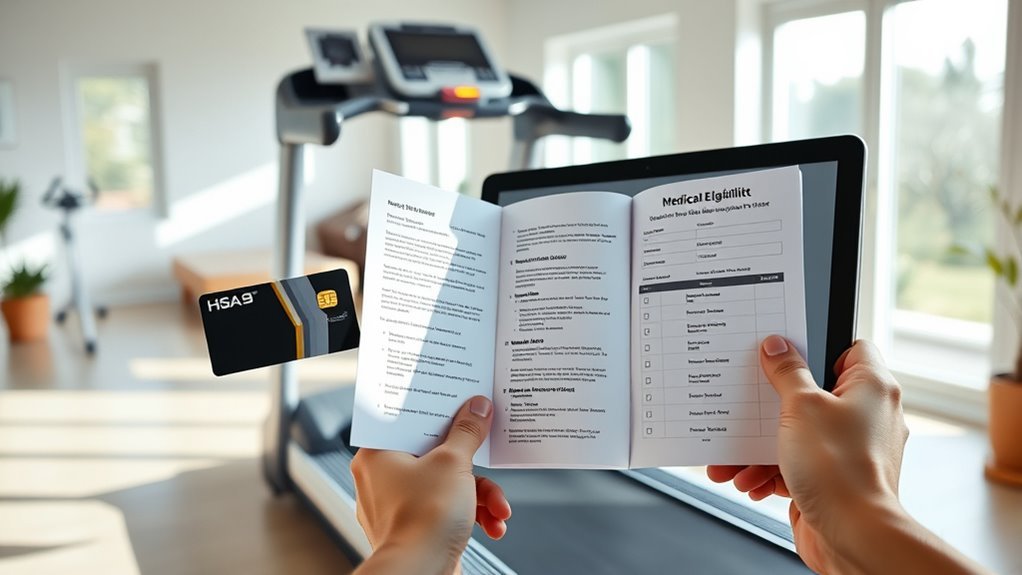
To determine if your treadmill qualifies for HSA funds, start by reviewing the medical necessity documentation from your healthcare provider.
Begin by checking your healthcare provider’s documentation to confirm your treadmill’s medical necessity for HSA coverage.
Then, consider these key points:
- Medical Purpose: Confirm the treadmill is prescribed to treat or manage a specific medical condition.
- Equipment Type: Check if the treadmill model meets any specific criteria outlined by your HSA plan.
- Usage Justification: Ensure the treadmill use is primarily for medical benefit, not general fitness.
- Plan Guidelines: Review your HSA plan’s rules on exercise equipment eligibility to avoid disallowed purchases.
Documentation and Prescription Requirements
What documentation do you need to use your HSA funds for a treadmill? First, you’ll need a letter of medical necessity or prescription from your healthcare provider. This document should clearly state that the treadmill is required to treat or manage a specific medical condition.
Keep this prescription handy because your HSA administrator may request it to verify eligibility. Also, be sure to keep your purchase receipt along with any product descriptions that explain the treadmill’s features. This helps prove it meets medical needs.
Without these documents, your HSA provider might reject the expense. So, by securing proper documentation upfront, you’ll make sure your treadmill purchase complies with IRS rules. This way, you can avoid potential tax penalties or denied claims.
And don’t forget to always check your HSA plan’s guidelines to confirm their specific documentation requirements. It’s better to be safe than sorry!
Using Your HSA Card vs. Reimbursement Process
You can use your HSA card to pay for a treadmill directly if the seller accepts it, making the process quick and simple.
Alternatively, you can pay out of pocket and submit a claim for reimbursement later. This requires keeping receipts and following specific steps.
Understanding both options helps you choose the method that works best for your situation.
HSA Card Payment
Wondering whether to use your HSA card directly or go through the reimbursement process when buying a treadmill? Paying with your HSA card can simplify the purchase, letting you avoid out-of-pocket expenses upfront.
Here’s how using your HSA card benefits you:
- Instant payment at checkout without needing to file claims later.
- Automatic tracking of your eligible expenses through your HSA provider.
- Reduced paperwork since the transaction is recorded electronically.
- Quick access to funds, making it easier to complete your purchase.
Keep in mind, your treadmill must qualify as an eligible medical expense to use your HSA card. Always check with your HSA administrator before buying to ensure the expense is covered and avoid potential tax penalties.
Reimbursement Steps Explained
Although using your HSA card for treadmill purchases offers convenience, understanding the reimbursement process can help you decide which method suits you best. With the reimbursement approach, you pay upfront using your personal funds, then submit a claim to your HSA provider.
You’ll need to keep your receipt and fill out a reimbursement form, either online or on paper. Once approved, you’ll get reimbursed from your HSA account.
This method gives you more control, especially if your HSA card doesn’t cover the purchase directly. However, it requires careful record-keeping and may delay when you see the refund.
Using your HSA card is faster, but reimbursement lets you pay first and claim later, which can be useful if the treadmill seller doesn’t accept HSA cards. Choose the option that fits your payment preferences and HSA rules.
Potential Tax Implications and Reporting
Before using your HSA to buy a treadmill, you need to understand the tax deductibility criteria to confirm your purchase qualifies. You’ll also want to know the reporting requirements to avoid any surprises during tax season.
Let’s break down what you need to keep in mind. It’s easier than it sounds, and being informed can save you money and hassle later on.
Tax Deductibility Criteria
How can you guarantee your treadmill purchase qualifies for tax deductions through your HSA? First, make sure the treadmill is prescribed by a healthcare professional to treat a specific medical condition.
Next, confirm that it’s primarily for medical use, not just general fitness. You want to be clear on that distinction.
Third, keep detailed receipts and the prescription documentation as proof. These records are important if you ever need to verify the expense.
Finally, double-check that the expense meets IRS guidelines for qualified medical expenses. It’s always good to be certain.
- Obtain a doctor’s prescription specifying medical necessity.
- Use the treadmill mainly for treating the condition, not general exercise.
- Retain all purchase receipts and the prescription for your records.
- Check IRS rules to confirm the treadmill qualifies as a medical expense.
Following these steps helps you avoid tax issues and maximize your HSA benefits. It’s really about staying organized and informed.
Reporting Requirements Explained
When you use your HSA to buy a treadmill, you need to understand the reporting requirements to avoid unexpected tax consequences. The IRS requires you to report any distributions from your HSA on Form 8889 when you file your taxes.
If the treadmill qualifies as a medical expense, the distribution is tax-free. However, if it doesn’t meet the IRS criteria, you’ll need to include the amount as taxable income and may owe a 20% penalty.
Make sure to keep detailed records, including your doctor’s recommendation and receipts, to justify the purchase if questioned. Proper documentation helps you prove the expense’s medical necessity and minimizes audit risks.
Reporting accurately guarantees you can use your HSA benefits without triggering additional taxes or penalties. So, stay organized and keep everything handy!
Tips for Choosing the Right Treadmill for Medical Use
Since medical use demands specific features, you’ll want to focus on treadmills that offer stability, adjustable speed settings, and easy-to-use controls. Choosing the right treadmill guarantees safety and effectiveness for your health needs.
Consider these tips:
- Stability and Support: Look for a wide, non-slip belt and sturdy handrails to prevent falls.
- Speed and Incline Adjustments: Select models with customizable settings to match your rehabilitation or exercise plan.
- User-Friendly Interface: Ensure controls are simple to operate, especially if mobility or dexterity is limited.
- Size and Portability: Pick a treadmill that fits your space and can be moved if needed.
Alternatives to Using HSA for Fitness Equipment Purchases
Although HSAs offer tax advantages for medical expenses, you might find other ways to finance your fitness equipment that better suit your budget or goals. For example, you could utilize a flexible spending account (FSA) if your plan covers fitness gear, though rules vary.
Another option is a health-related credit card with rewards or low interest, helping you spread out payments. You might also consider personal loans or financing plans from retailers, which often come with promotional rates.
Additionally, some insurance policies or wellness programs may offer reimbursements or discounts on fitness equipment. Finally, saving up and paying cash can avoid interest or penalties.
Exploring these alternatives ensures you choose the financing method that fits your financial situation best.
Frequently Asked Questions
Can I Combine HSA Funds With Other Health Accounts to Buy a Treadmill?
You can’t directly combine HSA funds with other health accounts like FSAs or HRAs to buy a treadmill.
However, you can use each account separately for eligible expenses, if the treadmill qualifies as a medical necessity.
Are There Restrictions on Treadmill Brands When Using HSA Funds?
No, your HSA won’t judge your treadmill brand choices—it’s not a fitness snob. Just make sure the treadmill is primarily for medical use, and you’ve got a legit expense; then go ahead and pick your favorite brand.
How Often Can I Purchase Exercise Equipment With HSA Money?
You can buy exercise equipment with your HSA as often as you need, as long as each purchase qualifies as a medical expense.
Just keep receipts and verify the item meets IRS guidelines for eligibility.
It’s pretty straightforward, but staying organized helps if you ever need to prove it.
Can a Family Member Use My Hsa-Purchased Treadmill for Therapy?
Sure, your family member can hop on the HSA-funded treadmill for therapy—because nothing says “medically necessary” like shared cardio.
Just keep receipts and doctor’s notes handy to avoid IRS running in circles chasing you.
Does Buying a Treadmill With HSA Affect My Insurance Premiums?
No, buying a treadmill with your HSA doesn’t directly affect your insurance premiums. Your premiums are based on broader factors like your plan and overall health.
Using HSA funds for equipment won’t increase or decrease those costs. So, feel free to use your HSA without worrying about your premiums going up or down.
Conclusion
Now that you know how to use your HSA for buying a treadmill, remember to check eligibility and get any necessary prescriptions—don’t treat it like a rotary phone, outdated and forgotten.
Using your HSA card directly can be simpler, but reimbursement’s an option too. Keep your documentation handy to avoid tax surprises.
With the right steps, you can invest in your health wisely. Buying a treadmill with your HSA blends modern benefits with a touch of old-school diligence.
So, when thinking about how to buy my treadmill with my HSA, always verify that the purchase qualifies under IRS rules. Make sure you keep receipts and any doctor’s notes if needed. This way, you can make the most of your health savings account and stay on track—literally and financially!