How Many Calories Are Burned on a Vibration Plate?
You typically burn about 50 to 100 calories during a 15 to 30-minute vibration plate session, depending on how actively you engage your muscles. The rapid vibrations cause muscle contractions that boost your metabolic rate slightly, offering a low-impact calorie burn.
While it’s not as intense as cardio, it’s a great way to complement your fitness routine. It helps improve muscle tone and circulation, making it a useful tool for overall health.
If you want to explore how to maximize these benefits and compare it to other workouts, there’s more to discover.
Let’s dive deeper into how vibration plates can fit into your exercise regimen.
Key Takeaways
- A typical vibration plate session burns approximately 50 to 100 calories in 15 to 30 minutes.
- The number of calories you burn depends on a few things like the vibration frequency, how long you use the plate, and how actively you engage your muscles.
- If you crank up the vibration intensity or add some dynamic exercises while on the plate, you’ll burn more calories.
- These plates work by causing rapid muscle contractions, which boost your metabolic rate. But keep in mind, they usually burn fewer calories than traditional cardio workouts.
- Using a vibration plate regularly can be a nice complement to your other fitness routines. Over time, it can help gradually increase your total daily calorie burn.
Understanding Vibration Plate Technology
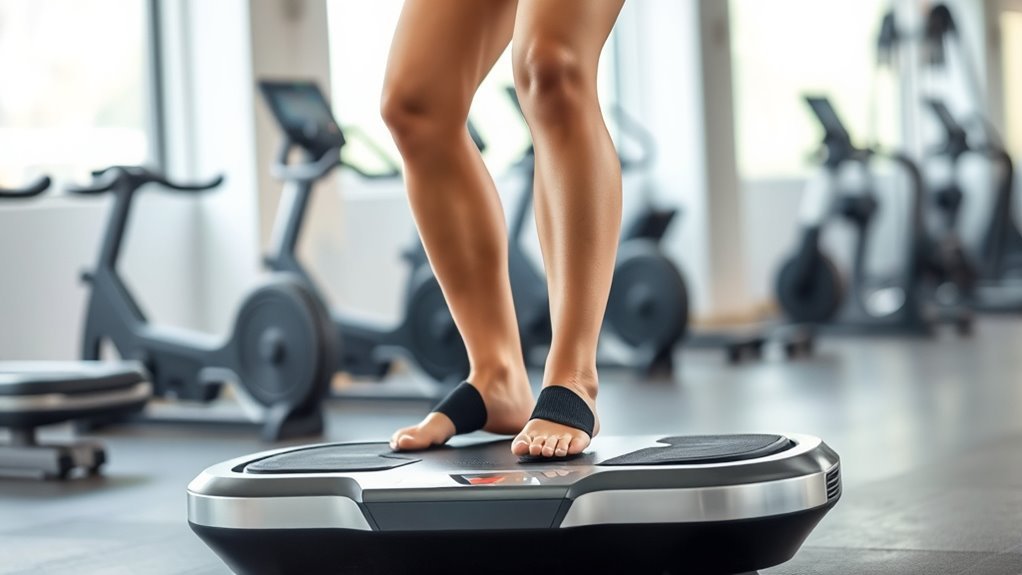
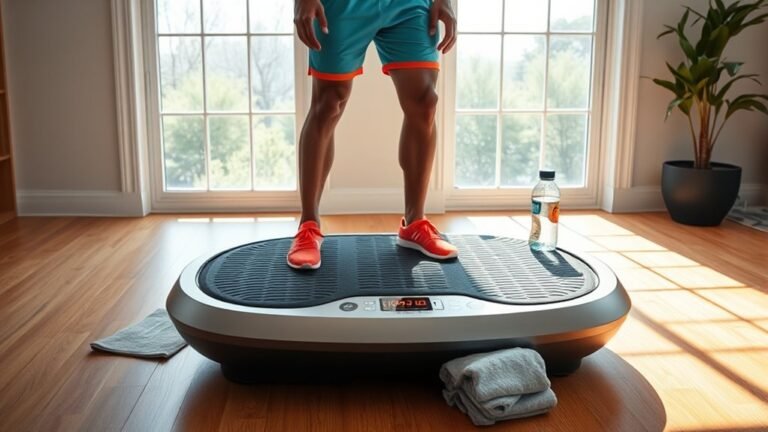
Although vibration plates might seem simple at first glance, they use advanced technology to stimulate your muscles through rapid oscillations. When you stand, sit, or perform exercises on the plate, it vibrates at specific frequencies, creating a unique environment for your body.
This technology causes your muscles to react to the vibrations by making small, quick adjustments to maintain balance. The machines often allow you to adjust vibration speed and amplitude, tailoring the experience to your fitness level.
You’ll find that the design includes a platform that moves in different patterns—like side-to-side or up-and-down—to target various muscle groups. This setup helps engage your body differently than traditional workouts, making it a versatile tool for fitness and rehabilitation.
How Vibration Plates Stimulate Muscle Activity
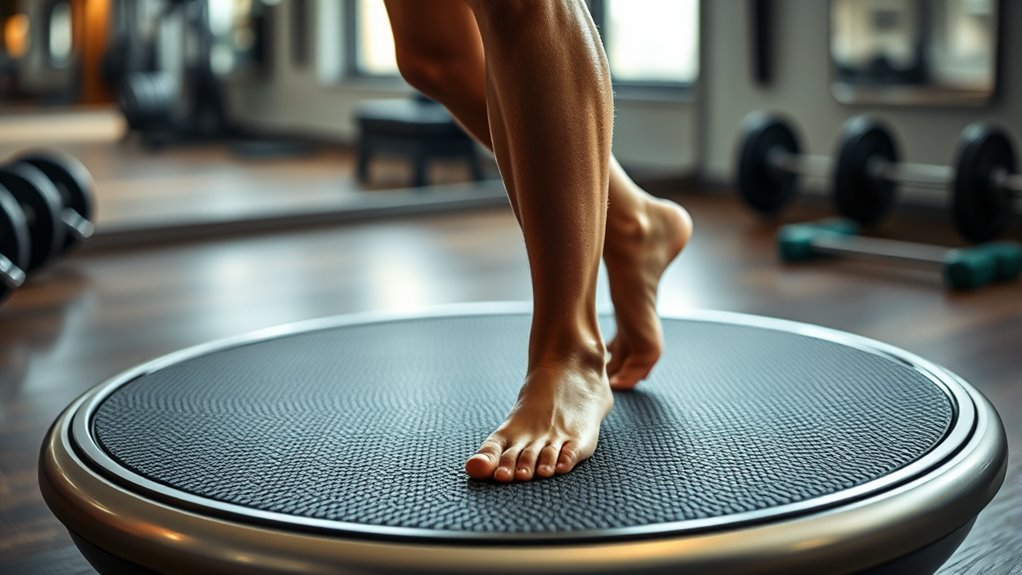
When you stand on a vibration plate, its rapid movements cause your muscles to contract repeatedly. The frequency of these vibrations directly affects how your muscles respond and engage.
It’s pretty interesting once you get it. Understanding this mechanism helps you see how vibration plates boost muscle activity effectively.
Muscle Contraction Mechanism
Because vibration plates create rapid oscillations, they force your muscles to contract reflexively to maintain balance and stability. This involuntary muscle contraction activates your muscle fibers more intensely than regular exercise.
Your nervous system detects the vibrations and sends signals to your muscles, causing them to twitch and engage repeatedly. This process helps improve muscle tone and strength over time.
| Vibration Effect | Muscle Response |
|---|---|
| Rapid oscillations | Reflexive muscle contractions |
| Balance disruption | Increased muscle fiber activation |
| Nervous system input | Muscle twitching and engagement |
| Continuous stimulus | Enhanced muscle tone and strength |
Frequency and Muscle Response
As vibration plates oscillate at different frequencies, your muscles respond uniquely to each setting, affecting the intensity and type of muscle activation you experience.
Lower frequencies typically target larger muscle groups with slower, more controlled contractions, while higher frequencies induce rapid, small muscle twitches that increase muscle engagement.
By adjusting the frequency, you can customize your workout to either build strength or enhance endurance.
Here’s how frequency influences muscle response:
- Low frequencies (around 20-30 Hz) promote deep muscle activation and relaxation.
- Medium frequencies (30-50 Hz) increase muscle tone and improve circulation.
- High frequencies (above 50 Hz) trigger fast twitch fibers and intense contractions.
- Varying frequencies prevent muscle adaptation, maximizing calorie burn and effectiveness.
Choosing the right frequency optimizes your vibration plate workout. Give it a try and see what feels best for your goals!
Average Calorie Burn During Vibration Plate Sessions
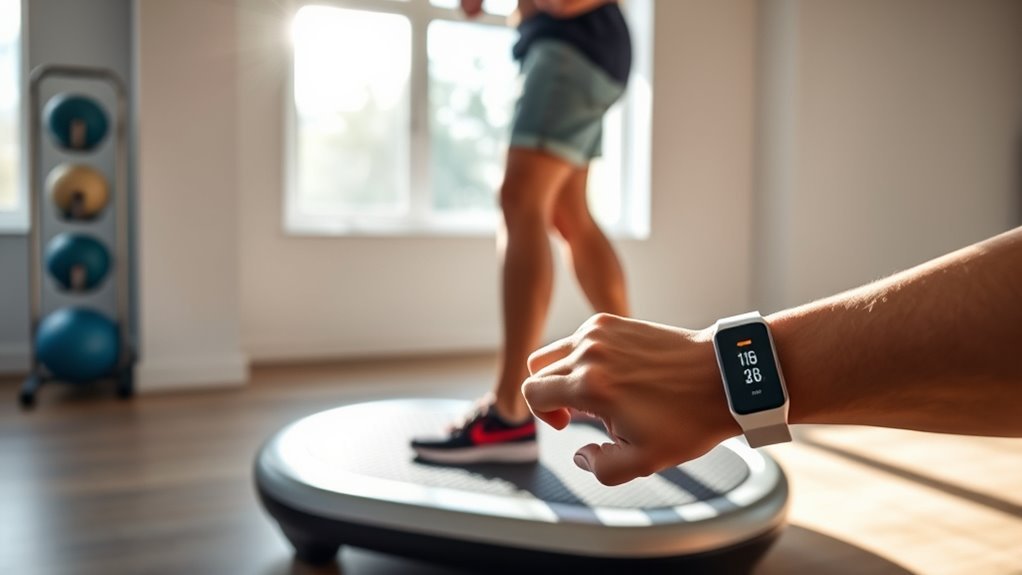
Although vibration plates don’t burn as many calories as intense cardio workouts, they still help you torch a noticeable amount during each session. On average, you can expect to burn between 50 to 100 calories in a typical 15 to 30-minute vibration plate workout.
This range depends on how actively you engage your muscles while standing, squatting, or performing exercises on the platform. The vibrations stimulate muscle contractions, increasing your metabolic rate slightly, which contributes to calorie burn.
While this isn’t a substitute for running or cycling, incorporating vibration plate sessions can complement your fitness routine by adding some extra calorie expenditure. So, if you’re looking for a low-impact way to boost your daily calorie burn, vibration plates offer a modest but worthwhile option.
Factors Affecting Calorie Expenditure on Vibration Plates
Your calorie burn on a vibration plate depends a lot on the intensity level you choose. The higher the vibration frequency, the more energy you’ll use.
Plus, your body composition plays a big role in how many calories you actually burn during each session. It’s not just about how hard the machine works, but also about how your body responds to it.
Vibration Intensity Levels
When you increase the vibration intensity on a plate, your muscles have to work harder to maintain balance and stability, which boosts calorie burn. Higher intensity means your body activates more muscle fibers, leading to greater energy expenditure.
That said, it’s super important to find a level that challenges you without causing discomfort or injury.
Consider these factors when adjusting vibration intensity:
- Frequency: Higher vibrations per second increase muscle activation.
- Amplitude: Larger movement ranges demand more effort.
- Session duration: Longer sessions at moderate intensity can be effective.
- Exercise complexity: Combining vibrations with dynamic movements raises calorie burn.
User’s Body Composition
Since body composition influences how many calories you burn on a vibration plate, understanding your muscle mass and fat percentage can help tailor your workouts.
Muscle tissue burns more calories at rest than fat, so if you have higher muscle mass, you’ll likely burn more calories during your session. Conversely, higher fat percentage means fewer calories burned overall.
Knowing this, you can adjust intensity or duration to maximize your results.
| Body Composition Factor | Impact on Calorie Burn |
|---|---|
| High Muscle Mass | Increases calorie burn |
| Low Muscle Mass | Decreases calorie burn |
| High Fat Percentage | Lowers calorie burn |
| Low Fat Percentage | Enhances calorie burn |
| Balanced Composition | Optimizes calorie expenditure |
Comparing Vibration Plate Workouts to Traditional Exercise
Although vibration plate workouts can boost muscle engagement, they don’t typically burn as many calories as traditional exercises like running or cycling. When you compare the two, traditional workouts generally demand more energy and sustain higher heart rates, leading to greater calorie expenditure.
Vibration plates mainly stimulate muscles through rapid contractions, which is effective for toning but less intense overall. So, they work your muscles differently but might not give you that big calorie burn.
Consider these points when weighing your options:
- Traditional cardio increases cardiovascular endurance and calorie burn.
- Vibration plates improve muscle activation with less joint impact.
- Calorie burn on vibration plates is usually lower but offers recovery benefits.
- Combining both methods can balance calorie burn with muscle strengthening.
Understanding these differences helps you choose workouts that fit your fitness goals. It’s all about what you want to achieve and how you like to move.
Enhancing Calorie Burn With Exercises on Vibration Plates
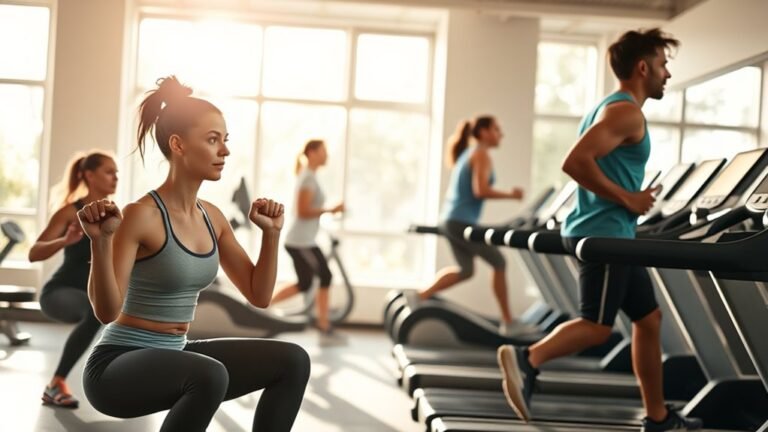
To boost your calorie burn on a vibration plate, you can combine specific exercises that engage multiple muscle groups simultaneously. Start with squats or lunges to activate your legs, glutes, and core.
Adding upper-body movements like push-ups or planks intensifies the workout and increases energy expenditure. You can also try dynamic exercises such as jumping jacks or mountain climbers on the plate to elevate your heart rate further.
Keep your movements controlled to maximize muscle activation and avoid injury. Incorporating short bursts of high-intensity exercises with brief rest periods enhances calorie burn efficiently.
Potential Health Benefits Beyond Calorie Burning
Incorporating varied exercises on a vibration plate doesn’t just ramp up calorie burn—it offers a range of health benefits that go beyond weight management. When you use a vibration plate regularly, you can experience improved muscle strength and tone because the vibrations cause your muscles to contract rapidly.
This can enhance your balance and coordination, making daily movements easier. It also stimulates blood circulation, which helps with faster recovery and reduced muscle soreness.
Additionally, vibration plates may promote better bone density by encouraging bone growth through mechanical stimulation. Here’s what you can expect:
- Enhanced muscle activation and strength
- Improved balance and coordination
- Increased blood flow and quicker recovery
- Support for bone health and density
These benefits make vibration plates a valuable addition to your fitness routine. Give it a try and see how it works for you!
Tips for Maximizing Results With Vibration Plates
When you want to get the most out of your vibration plate workouts, focusing on proper form and consistency is key. Stand with your knees slightly bent and engage your core to improve balance and muscle activation.
Proper form and consistency are essential: keep knees slightly bent and engage your core for better balance and muscle activation.
Mix up your positions—try squats, lunges, or planks—to target different muscle groups and prevent plateaus. Start with shorter sessions and gradually increase the duration as your body adapts.
Pair your vibration plate routine with strength training or cardio for better calorie burn. Don’t forget to stay hydrated and wear comfortable, supportive shoes to reduce strain.
Finally, set realistic goals and track your progress to stay motivated. By following these tips, you’ll boost your results and make the most of your vibration plate workouts.
Frequently Asked Questions
Are Vibration Plates Safe for People With Joint Problems?
Yes, vibration plates can be safe for people with joint problems if you use them correctly.
You should start slowly, consult your doctor, and avoid high-intensity settings. This helps prevent aggravating your joints or causing pain.
Taking these steps makes a big difference in how your body responds. So, always listen to your body and take it easy at first.
Can Vibration Plates Help Improve Bone Density?
Yes, vibration plates can help improve bone density by stimulating bone cells and promoting bone growth.
You’ll want to combine this with weight-bearing exercises and consult your doctor for a safe, effective routine.
It’s all about finding what works best for your body. So, getting professional advice is a smart move!
How Long Should a Typical Vibration Plate Session Last?
Wondering how long you should use a vibration plate? Typically, sessions last 10 to 20 minutes.
You don’t want to overdo it—short, consistent workouts work best for maximizing benefits without fatigue. Just keep it steady and listen to your body!
Do Vibration Plates Help Reduce Cellulite?
Yes, vibration plates can help reduce cellulite by improving blood circulation and stimulating muscle contractions.
If you use them consistently, you’ll likely notice smoother skin and firmer muscles over time. Keep at it!
Can Vibration Plates Be Used During Pregnancy?
Better safe than sorry; you shouldn’t use vibration plates during pregnancy without consulting your doctor.
The vibrations might be risky for you and your baby, so always prioritize professional advice before trying new exercises.
Conclusion
If you think standing on a vibration plate is just a fancy way to chill, think again—you could be torching calories like a pro athlete! While it won’t replace a marathon, this tech can seriously boost your calorie burn, especially when you add exercises.
So, don’t just stand there—shake things up and watch your body work harder than you ever imagined. With the right moves, you’ll turn a simple vibration into a calorie-burning powerhouse!
Using a vibration plate effectively can increase your metabolism and engage multiple muscle groups simultaneously. This makes it a great tool for those looking to burn calories without intense cardio sessions.
Incorporating vibration plate workouts into your routine can enhance your calorie burn and aid in weight management. So, if you want to boost your fitness and burn calories efficiently, give the vibration plate a try!