How Many Laps Around a Gym Equal One Mile?
You’ll usually need to run about 10 laps around a standard indoor gym track to complete one mile. That’s because many gym tracks measure roughly 1/10th of a mile per lap.
But remember, gym track sizes can vary quite a bit—from 100 meters to 200 meters or more—so the exact number of laps might be different depending on where you’re running.
It’s a good idea to measure your specific track’s length. This way, you can tally laps accurately and plan your workout better.
Keep going to discover how to measure your track and adjust your run for precise distance tracking.
Key Takeaways
- Most indoor gym tracks are 1/10 mile per lap, so 10 laps equal one mile.
- But track sizes can vary quite a bit, so it’s a good idea to measure the lap length to know exactly how many laps you need for a full mile.
- On a 200-meter track, for example, it takes roughly 8 laps plus a little extra distance to make one mile.
- You can use measuring tools or GPS devices to find out your gym track’s precise lap length.
- Knowing the exact lap distance helps you calculate miles accurately and track your workout progress better.
Understanding the Standard Length of a Gym Track
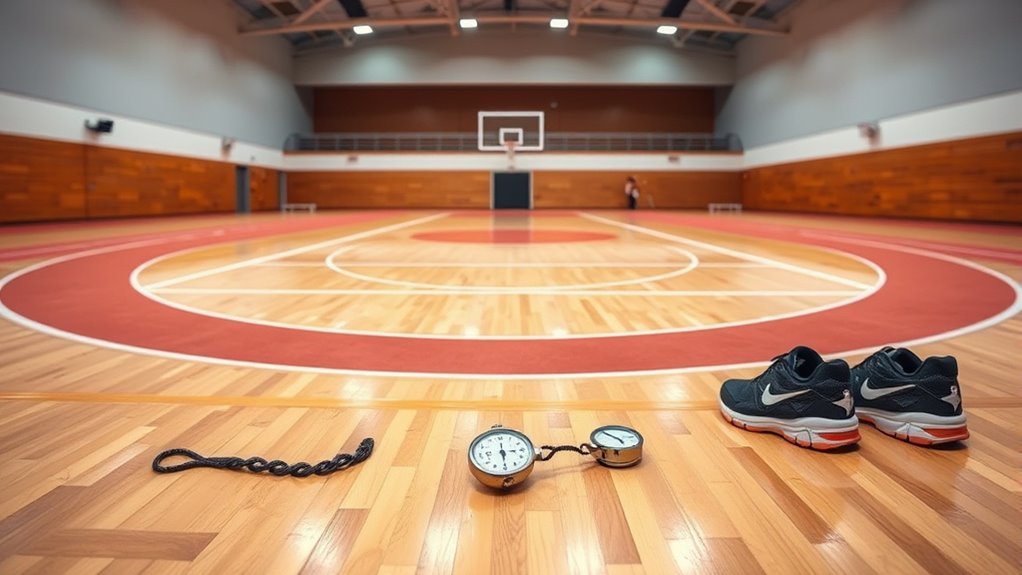
Although gym tracks vary, most standard indoor gym tracks measure 1/10th of a mile per lap. This means that when you run around the track ten times, you complete one mile.
Knowing this helps you keep track of your distance without guessing. The track’s size usually fits inside a typical gymnasium, making it convenient for indoor workouts.
Tracking distance becomes easy as the gym track fits perfectly inside a standard gymnasium.
You don’t have to worry about measuring distances manually because the laps provide a straightforward way to track your progress. When you understand this basic length, you can set realistic goals for your running sessions.
It also helps you pace yourself by knowing how far you’ve gone with each lap. This standard length makes indoor running simple and effective.
Variations in Gym Track Sizes

How do gym track sizes differ from one facility to another? You’ll find that gym tracks vary widely in length depending on the space available and the building’s design.
Some gyms feature short tracks measuring around 100 meters, while others have longer tracks closer to 200 meters or even more. The width and lane markings can also change, affecting your running experience.
Because of these differences, the number of laps you need to complete a mile will vary. You can’t always rely on a fixed number like four laps; instead, you’ll want to check the specific track length at your gym.
Knowing the exact length helps you accurately calculate how many laps equal a mile during your workout. That way, you can keep track of your progress without any guesswork.
Calculating Laps for a Mile on a 200-Meter Track

When you run on a 200-meter track, calculating the number of laps needed to complete a mile becomes straightforward once you know the conversion between meters and miles. One mile equals approximately 1,609 meters.
Since each lap on a 200-meter track covers 200 meters, you simply divide 1,609 by 200. Doing the math, you get about 8.045 laps. This means you need to run just over 8 laps to complete a mile.
To be exact, you’d run 8 full laps plus an additional 9 meters. For practical purposes, rounding to 8 laps is common, but if you want precise mileage, you can add a little extra distance after the eighth lap. This helps you track your mile runs accurately on a 200-meter track.
Calculating Laps for a Mile on a 400-Meter Track
When you run on a 400-meter track, understanding the track length is key to figuring out how many laps make a mile. Since a mile is about 1,609 meters, you’ll need to calculate how many 400-meter laps fit into that distance.
Let’s break down the math to see exactly how many laps you should run. It’s easier than it sounds once you get the hang of it!
Track Length Basics
Although a standard outdoor track measures 400 meters per lap, understanding how many laps you need to run to complete a mile can be tricky. One lap covers 400 meters, but a mile is slightly longer—about 1,609 meters.
Knowing this difference helps you plan your workout accurately. When you step onto the track, remember that the length is fixed, so your distance depends entirely on how many laps you complete.
Indoor gym tracks often vary in length, so it’s essential to check their measurements before starting. By grasping these basics, you’ll better gauge your pace and distance.
This foundation sets you up for successfully tracking your runs without confusion or guesswork.
Lap-to-Mile Conversion
Understanding the length of a standard 400-meter track sets the stage for figuring out how many laps you need to run to cover a mile. Since one mile equals 1,609.34 meters, you can calculate how many laps to complete by dividing 1,609.34 by 400.
Doing the math, you get roughly 4.02 laps. This means you’ll need to run just over four full laps to cover a mile on a 400-meter track.
Most runners round this up to four laps plus an extra 9 meters or so. Knowing this helps you pace yourself accurately and track your mileage during workouts or races.
How to Measure Your Gym Track’s Length
To figure out how many laps you need for a mile, start by measuring your gym track’s length. Use a measuring tape to find the distance around the track, then calculate the distance per lap.
This way, you’ll know exactly how many laps add up to a mile. It makes tracking your runs much easier!
Measuring Track Dimensions
When you want to know how many laps equal a mile on your gym track, the first step is measuring its exact length. You’ll need to get accurate dimensions to guarantee your calculations are right.
Here’s how to measure your gym track’s length effectively:
- Use a measuring tape or wheel for precise distance tracking.
- Measure along the innermost lane to get the shortest lap length.
- Mark start and end points clearly to avoid confusion.
- Walk the curve carefully, following the track’s path exactly.
- Repeat measurements to confirm consistency and accuracy.
It’s a bit of work, but it really pays off. Taking your time here makes sure your lap counting is spot on!
Calculating Distance Per Lap
Although measuring your gym track is essential, calculating the exact distance you cover in each lap guarantees you know how many laps make up a mile. Start by measuring the length and width of the gym floor where you plan to run. Use a measuring tape to get accurate numbers.
Next, determine the path you’ll take—usually the innermost edge of the track. Calculate the perimeter by adding twice the length and twice the width. This gives you the distance for one lap.
If the corners are rounded, include the curved sections by measuring their arc lengths or approximating them as quarter circles. Once you have the total lap distance, divide one mile (5,280 feet) by that number to find how many laps equal a mile.
This method guarantees you track your running distance precisely. It’s a simple way to make sure every step counts!
Tips for Tracking Distance Without a Measured Track
If you don’t have access to a measured track, you can still accurately track your distance by using simple tools like a GPS watch or a smartphone app. These devices use satellite data or phone sensors to estimate how far you’ve gone, even indoors with some apps.
You can also pace yourself by counting laps once you know the approximate length of your route.
Here are some tips to help you track distance without a measured track:
- Use GPS-enabled devices or apps for real-time distance tracking
- Measure one lap manually with a tape measure or wheel first
- Count your steps and calculate distance using your average stride length
- Use online maps to measure your running route outside
- Record lap times to estimate distance based on your speed
These methods keep your workouts accurate and motivating. Give them a try and see what works best for you!
Benefits of Running Indoors on a Gym Track
Tracking your distance accurately without a measured track can be challenging, but running indoors on a gym track offers a straightforward solution.
When you run inside, you don’t have to worry about weather conditions like rain, wind, or extreme heat. That means you can stick to your routine consistently without interruptions.
Gym tracks also provide a controlled environment where distractions are minimal. This helps you focus on your pace and form, which is super important.
Plus, the flat, even surface reduces the risk of injury compared to uneven outdoor terrain. You can easily track your laps since gym tracks are typically standardized, making it simple to know exactly how far you’ve run.
All these benefits help you stay motivated and improve your running efficiently indoors. It’s a great way to keep up your fitness anytime!
Adjusting Your Workout Based on Track Size
When you adjust your workout based on the size of the track, you can make sure your training stays effective and accurate. Different gyms have tracks with varying lap lengths, so knowing the exact distance per lap helps you calculate how many laps equal a mile.
This adjustment allows you to set realistic goals and track progress precisely. Here’s how to tailor your workout:
- Measure the track’s lap distance using a measuring wheel or gym info.
- Calculate the number of laps needed to complete your target mileage.
- Adjust your pace to fit the track’s length and your fitness goals.
- Use a stopwatch or fitness tracker to monitor time per lap.
- Reassess lap measurements regularly if the track changes or you switch gyms.
Frequently Asked Questions
Can Running Laps in a Gym Improve Cardiovascular Health?
Yes, running laps in a gym can improve your cardiovascular health. You’ll boost your heart and lung function, increase endurance, and burn calories.
All while staying safe indoors regardless of weather. Keep consistent!
What Shoes Are Best for Running on a Gym Track?
Think of your shoes as a ship steering smooth waters; you need lightweight, cushioned running shoes with good grip to glide effortlessly on a gym track.
They’ll protect your feet and boost your speed, keeping you steady. It’s all about feeling comfortable and confident as you run.
How Does Indoor Air Quality Affect Running Performance?
Indoor air quality directly affects your running performance by influencing oxygen intake and lung function. Poor air quality can cause fatigue, reduce endurance, and increase breathing difficulty.
Are There Safety Concerns Running Laps in a Crowded Gym?
Yes, you should watch out for safety when running laps in a crowded gym.
You might bump into others or slip on equipment. Stay alert, wear proper shoes, and choose less busy times to reduce risks.
How to Stay Motivated When Running Multiple Laps Indoors?
Staying motivated indoors is like fueling a fire; keep your playlist fresh, set small goals, and mix up your pace.
Visualize progress and reward yourself after laps to keep the energy burning strong throughout your run.
It really helps to break things down into manageable chunks. That way, you don’t get overwhelmed and can celebrate little wins along the way.
And hey, changing up your pace keeps things interesting. It stops the run from feeling like a dull routine, which makes it easier to stick with.
Conclusion
Whether your gym track measures 200 or 400 meters, you’ll find that running laps to complete a mile is simpler than you might think—coincidentally, the numbers line up nicely with common track lengths.
By knowing your track’s exact distance, you can tailor your workout effectively, turning each lap into a purposeful step toward your fitness goals.
So, lace up and let the track guide you—every lap counts, just as every mile does. Understanding how many laps around a gym equal one mile helps you stay motivated and track your progress easily.
Keep this in mind during your runs to maximize your gym workouts and achieve your running goals with confidence.