How Many Calories Do You Burn on a Treadmill?
You burn calories on a treadmill based on your speed, incline, workout duration, and body weight. The faster you go or the steeper the incline, the more energy you use. This means if you want to burn more calories, adjusting these factors can really help.
Heavier people burn more calories at the same pace because moving more weight requires extra effort. So, your body weight plays a big role in how many calories you burn.
Plus, longer sessions increase total calories burned, giving you more bang for your buck.
Also, monitoring your heart rate can help optimize intensity. Keeping an eye on it lets you work out smarter, not just harder.
Keep these factors in mind, and you’ll find effective ways to boost your calorie burn and fitness results.
Key Takeaways
- Calorie burn depends on speed, incline, duration, and individual body weight during treadmill exercise. Heavier individuals burn more calories at the same speed and incline because it takes more energy to move a bigger mass.
- Running burns more calories per minute than walking. Plus, adding an incline ramps up the intensity and calorie burn without needing to speed up.
- The longer you stay on the treadmill, the more calories you’ll burn overall. Keeping an eye on your heart rate helps you gauge workout intensity and track calories better.
- Mixing things up with interval training—switching speeds and inclines—can really maximize calorie burn and make your treadmill time more efficient. It keeps your body guessing and your workout interesting!
Factors Influencing Calorie Burn on a Treadmill
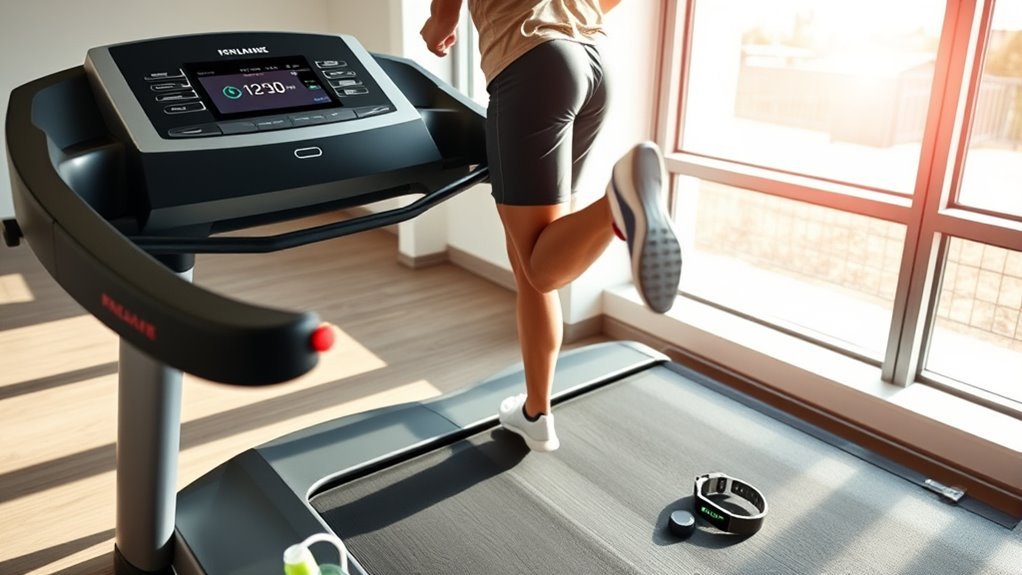
Although the number of calories you burn on a treadmill depends on several factors, understanding these variables can help you maximize your workout. First, your speed plays a vital role—running or walking faster demands more energy, so increasing your pace boosts calorie burn.
Next, incline settings make a big difference; walking or running uphill forces your muscles to work harder, increasing the intensity and calories burned. The duration of your treadmill session also matters—the longer you exercise, the more calories you expend.
Additionally, varying your workout with intervals, alternating between high and moderate speeds or inclines, can elevate your metabolism and calorie burn. By paying attention to these factors, you can tailor your treadmill routine to burn calories more efficiently and reach your fitness goals faster.
Impact of Body Weight on Calories Burned
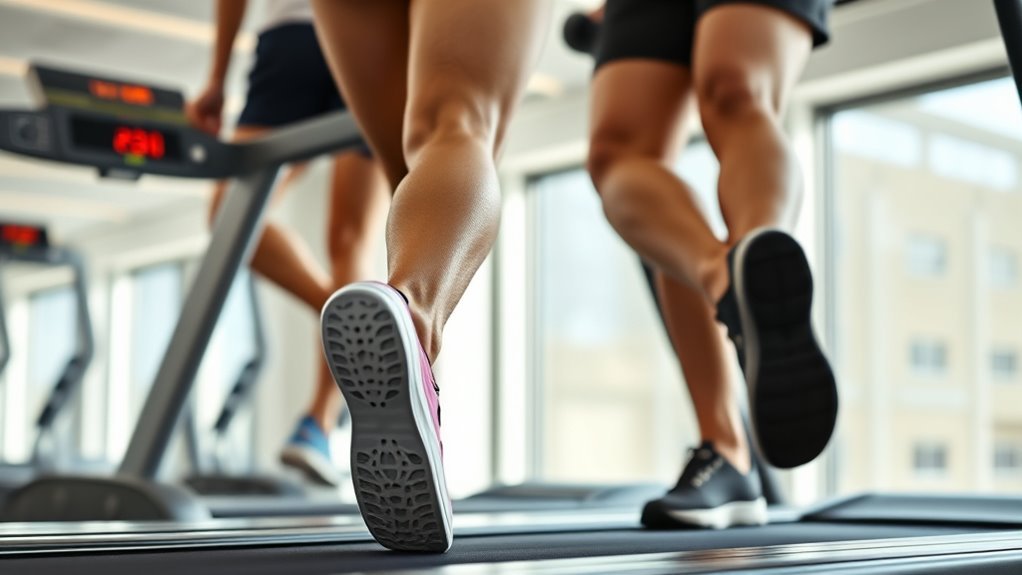
When you step on a treadmill, your body weight plays a big role in how many calories you burn. The heavier you are, the more energy your body uses to move, which means you burn more calories.
This can make treadmill workouts especially efficient for weight loss if you’re carrying extra pounds. So, if you’re looking to shed some weight, using the treadmill could really work in your favor.
Heavier Weight, More Burn
Since your body has to work harder to move more mass, you’ll burn more calories on a treadmill if you weigh more. This means if you and a friend walk at the same speed and incline, you’ll likely burn more calories simply because your body demands more energy.
Your weight directly influences the intensity of your workout, so heavier individuals generally see higher calorie counts per session.
Here’s a quick look at how weight affects calorie burn at a consistent treadmill pace:
| Weight (lbs) | Calories Burned (30 min) |
|---|---|
| 125 | 180 |
| 155 | 223 |
| 185 | 266 |
Keep this in mind as you track your treadmill workouts!
Weight Loss Efficiency
Understanding how your body weight impacts the calories you burn can help you maximize weight loss on a treadmill. The more you weigh, the more energy your body uses to move, so you burn more calories even at the same pace compared to someone lighter.
But it’s not just about weight—efficiency matters too. How your body uses energy plays a big role in burning calories.
To boost your weight loss efficiency, keep these tips in mind:
- Increase treadmill incline to engage more muscles and burn calories faster.
- Mix intervals of high and moderate intensity to challenge your metabolism.
- Maintain consistent workouts to improve endurance and calorie burn over time.
Give these a try, and you’ll likely see better results!
How Speed Affects Calorie Expenditure

The speed you choose on the treadmill plays a big role in how many calories you burn, whether you’re walking or running. Running generally burns more calories per minute, but walking at a brisk pace can still be effective.
Adding an incline can boost your calorie expenditure even further without increasing speed. So, if you want to switch things up, try that instead!
Walking vs. Running
Although both walking and running can help you burn calories, the speed at which you move substantially influences how many you expend. When you run, your body works harder, so you burn more calories in less time.
Walking burns fewer calories per minute but is easier to sustain longer, making it a great option for steady, low-impact exercise. To decide which works best for you, consider these points:
- Running typically burns about twice the calories per minute compared to walking at a moderate pace.
- Walking at a brisk pace still boosts calorie burn markedly without stressing your joints.
- Your fitness level and goals will determine whether you choose walking or running for calorie expenditure.
Adjust your treadmill speed to match your energy and goals for ideal results.
Impact of Incline
How much difference does incline make when you’re on a treadmill? Adding even a small incline markedly boosts the calories you burn.
When you increase the incline, your muscles work harder to overcome gravity, which means your body expends more energy. For example, walking at 3.5 mph on a 5% incline burns more calories than jogging at the same speed on a flat surface.
Even at lower speeds, a higher incline can elevate your heart rate and calorie burn. So, if you want to maximize your workout without increasing speed, crank up the incline.
It challenges your legs, glutes, and core more intensely, resulting in a more effective calorie-burning session. Adjusting incline is a smart way to enhance your treadmill workouts efficiently.
The Role of Incline in Increasing Workout Intensity
When you increase the incline on a treadmill, you challenge your muscles more than walking or running on a flat surface. This added effort boosts your heart rate and calorie burn without needing to speed up.
Incline workouts engage your glutes, hamstrings, and calves more intensely, making your legs stronger and improving endurance over time. By adjusting the incline, you can tailor your workout intensity to match your fitness goals without overstressing your joints.
Incline workouts strengthen your legs and boost endurance while letting you customize intensity safely.
Here’s why incline matters:
- It simulates uphill walking or running, increasing energy expenditure.
- It activates more muscle groups, promoting better strength and toning.
- It helps break workout monotony, keeping you motivated and consistent.
Using incline smartly transforms your treadmill session into a more effective calorie-burning workout. Give it a try—you might just find your new favorite way to work out!
Duration and Its Effect on Total Calories Burned
Since the longer you stay on the treadmill, the more calories you’ll burn, understanding how duration impacts your workout is key. Each additional minute adds to your total calorie expenditure, so even small increments matter.
However, it’s not just about staying on the treadmill longer; your body may adapt if the duration becomes too repetitive without intensity changes. For steady calorie burn, aim for continuous, moderate sessions that fit your fitness level.
If you push too hard for too long, fatigue might reduce your workout quality. Balancing duration with your energy and stamina guarantees consistent calorie burn and helps prevent burnout.
Ultimately, extending your treadmill time wisely boosts total calories burned and supports your fitness goals effectively.
Comparing Walking, Jogging, and Running on a Treadmill
Although all three activities—walking, jogging, and running—help you burn calories on a treadmill, they differ considerably in intensity and energy expenditure.
Walking is the least intense, suitable for beginners or recovery days, and burns fewer calories per minute.
Jogging offers a moderate challenge, increasing your heart rate and calorie burn efficiently.
Running is the most intense, quickly boosting your metabolism and torching the highest number of calories in a shorter time.
Here’s a quick comparison:
- Walking: Burns about 200-300 calories per hour, easy on joints
- Jogging: Burns roughly 400-600 calories per hour, balances intensity and endurance
- Running: Burns 600+ calories per hour, maximizes calorie burn but requires stamina
Choose what fits your fitness level and goals.
Using Heart Rate to Estimate Calorie Burn
Understanding your heart rate can give you a more accurate estimate of how many calories you burn on a treadmill. Your heart rate reflects how hard your body works during exercise, so tracking it lets you gauge the intensity of your workout.
Most treadmill machines or fitness trackers use your heart rate, along with your age, weight, and gender, to calculate calorie burn. To use this method effectively, wear a reliable heart rate monitor or use the treadmill’s sensors.
Aim to maintain a target heart rate zone that matches your fitness goals—typically between 50% and 85% of your maximum heart rate. By monitoring your heart rate, you can adjust your effort in real-time, making sure you’re burning calories efficiently and safely throughout your treadmill session.
Tips to Maximize Calorie Burn During Treadmill Workouts
To maximize calorie burn during your treadmill workouts, you need to challenge your body with varied intensity and smart techniques. Simply walking or jogging at a steady pace won’t push your metabolism enough.
Mix things up by incorporating intervals, incline changes, and speed variations to keep your muscles guessing and your heart rate elevated.
Here are three tips to help you burn more calories efficiently:
- Use Interval Training: Alternate between high-intensity sprints and moderate-paced recovery to boost calorie burn and improve endurance.
- Increase Incline: Walking or running uphill activates more muscles and burns more calories than flat surfaces.
- Add Resistance: Incorporate hand weights or increase treadmill resistance to engage your upper body and intensify the workout.
Frequently Asked Questions
Can Treadmill Workouts Aid in Weight Loss Without Dietary Changes?
Yes, treadmill workouts can help you lose weight without changing your diet, but combining exercise with healthy eating speeds results.
You’ll burn calories, increase metabolism, and build endurance, making your weight loss more effective and sustainable.
It’s kind of like giving your body a boost from two different angles.
Exercise alone can do a lot, but pairing it with good nutrition really takes things up a notch.
Is It Safe to Use a Treadmill Every Day?
Yes, you can use a treadmill daily if you listen to your body. Just vary the intensity, wear proper shoes, and include rest days to prevent injury.
Staying hydrated and warming up also keeps your workouts safe and effective. Easy, right? Just pay attention to how you feel!
How Does Treadmill Exercise Compare to Outdoor Running for Joint Health?
You’ll find treadmill running gentler on your joints thanks to its cushioned surface. This reduces impact compared to outdoor running on hard pavement.
It’s a safer, lower-impact option, especially if you’re prone to joint pain or injury. So, if your knees or ankles are feeling a bit sensitive, the treadmill might just be your best friend.
What Are the Best Treadmill Shoes for Preventing Injuries?
You’ll want treadmill shoes with good cushioning, arch support, and shock absorption to prevent injuries. Brands like Brooks, Asics, and Nike offer models designed for treadmill running that protect your joints and enhance stability.
It’s all about keeping your feet comfortable and your body safe while you run. So, choosing the right shoes can make a big difference in avoiding aches and strains.
Can Interval Training on a Treadmill Improve Cardiovascular Fitness Faster?
Sure, because who doesn’t want to torture themselves faster?
Yes, interval training on a treadmill boosts your cardiovascular fitness quicker by alternating intense bursts with recovery.
This method pushes your heart and lungs to adapt more efficiently than steady jogging.
Conclusion
Think of your treadmill workout like steering a ship—you control how fast and far you go. By adjusting your speed, incline, and duration, you can navigate through different calorie-burning seas.
Remember, your body weight and heart rate are your compass, helping you understand your progress. So, mix walking, jogging, or running, and use these tips to maximize your calorie burn.
Keep steering smart, and you’ll reach your fitness destination faster than you think! With the right approach, you can effectively burn calories on a treadmill and improve your overall health. Whether you’re aiming to lose weight or boost endurance, controlling your workout intensity and duration is key. So, hop on, set your pace, and watch those calories burn away as you move closer to your fitness goals!