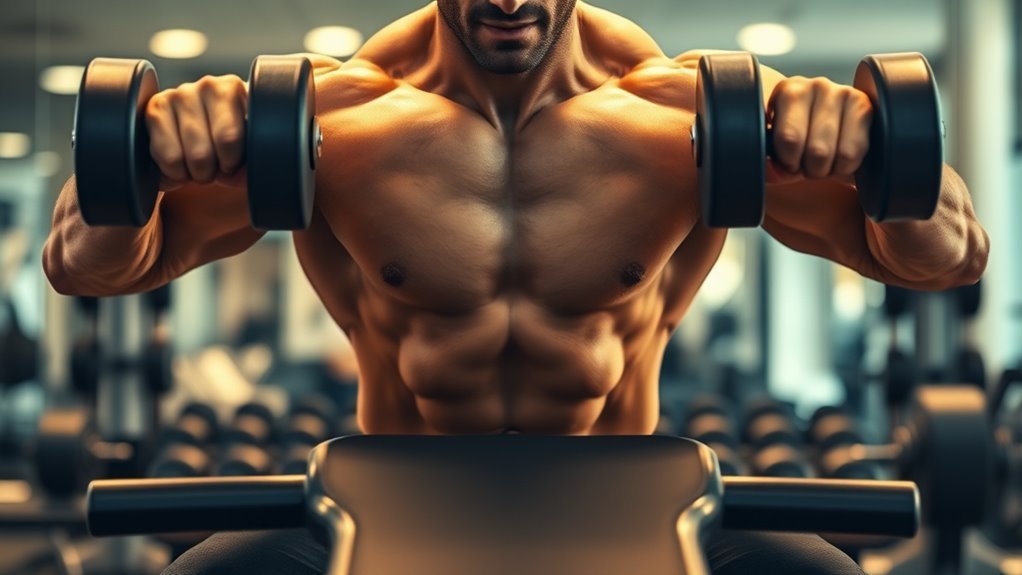
How to Build Pecs With Dumbbells Step by Step
To build your pecs with dumbbells effectively, start by choosing key exercises like dumbbell chest presses and flys. These moves target different areas of your chest, helping you develop balanced muscle growth.
Using dumbbells allows for a greater range of motion compared to machines or barbells, which can really enhance your chest workout.
Make sure to use proper form—control your reps, keep your elbows slightly bent, and maintain a stable position throughout each set.
Starting with manageable weights is important, so you can focus on technique before gradually increasing the load as you get stronger.
Don’t forget to warm up properly and rest between sets to avoid injury. These basics set a solid foundation for building your pecs with dumbbells.
Stick with it, and there’s plenty more you can do to optimize your chest gains ahead!
Key Takeaways
- Start with a warm-up using lighter dumbbells to prepare chest muscles and joints for heavier lifts. This helps get the blood flowing and reduces injury risk.
- Perform 3-4 sets of 8-12 reps of dumbbell chest presses and fly variations targeting different pec areas. Mixing up the exercises keeps things interesting and hits the muscles from various angles.
- Maintain proper form with controlled, slow reps, full range of motion, and stable body positioning to maximize muscle engagement. Quality over quantity is key here.
- Gradually increase dumbbell weight in small increments once target reps are completed comfortably to ensure progressive overload. This way, your muscles keep getting stronger without overdoing it.
- Prioritize recovery with adequate protein intake, sleep, and rest days to support muscle growth and prevent injury. Remember, muscles grow when you rest, not just when you train!
Understanding the Anatomy of the Pecs
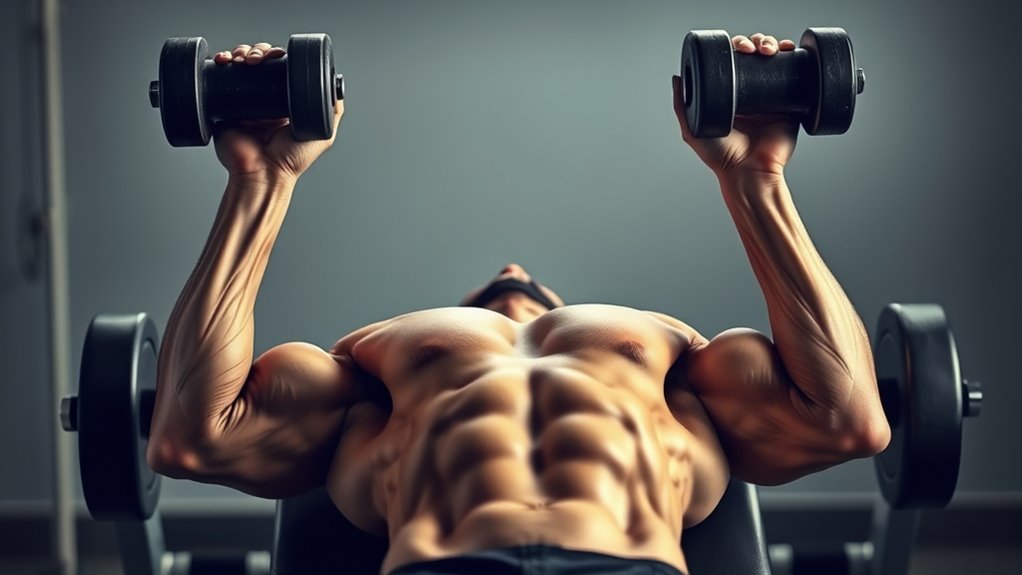
How do your pectoral muscles work during a workout? Your pectoral muscles, or pecs, consist mainly of two parts: the pectoralis major and the pectoralis minor.
Your pecs include the pectoralis major and minor, key muscles that activate during chest workouts.
The pectoralis major is the large, fan-shaped muscle covering the chest. It helps you move your arms across your body and rotate them inward. When you perform chest exercises, this muscle contracts to bring your arms together, like during a dumbbell fly or press.
The smaller pectoralis minor lies underneath and stabilizes your shoulder blade, aiding upper body movement. By understanding these muscles and their functions, you can better target them during your workouts.
Focusing on both parts ensures balanced development, improving strength and appearance efficiently as you train with dumbbells. It’s all about working smart to get the best results!
Benefits of Using Dumbbells for Chest Workouts
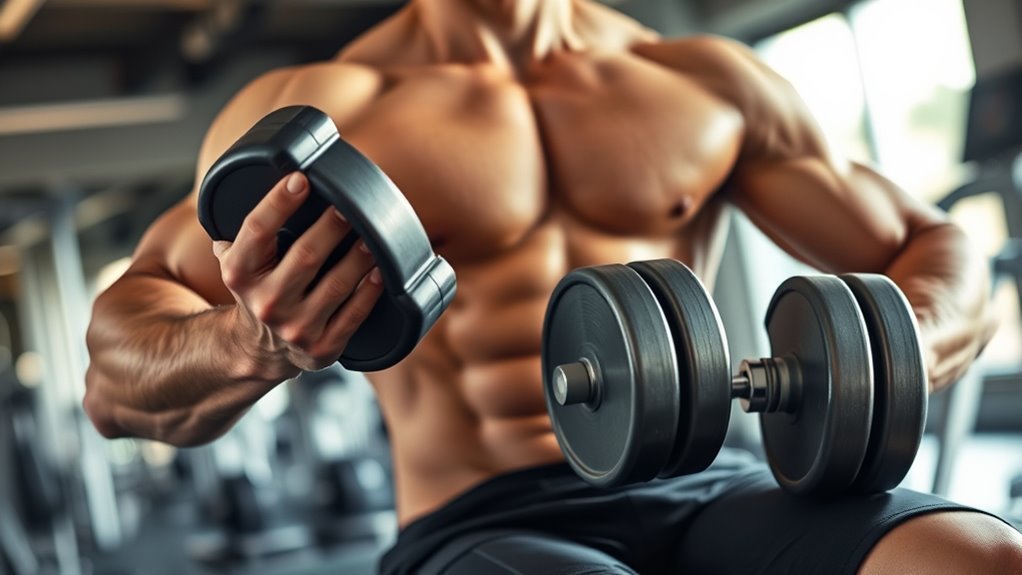
When you use dumbbells for chest workouts, you engage more muscle fibers for better activation. They also let you move through a greater range of motion, which helps build strength evenly.
Plus, dumbbells encourage balanced development by forcing each side of your chest to work independently. This way, you can avoid strength imbalances and improve overall muscle coordination.
Enhanced Muscle Activation
Because dumbbells allow for a greater range of motion compared to barbells or machines, you’ll engage more muscle fibers during each chest exercise. This enhanced activation helps you build stronger, more defined pecs faster.
Here’s why dumbbells boost muscle engagement:
- Stabilizer Muscle Recruitment: Dumbbells force your smaller stabilizer muscles to work harder, improving overall strength and coordination.
- Balanced Muscle Development: Each arm works independently, preventing one side from dominating and encouraging equal muscle growth.
- Varied Movement Patterns: You can adjust dumbbell angles to target different chest areas, maximizing muscle fiber involvement.
Improved Range Motion
Although barbells and machines provide stability, dumbbells let you move your arms through a fuller range of motion during chest exercises. This increased freedom allows your chest muscles to stretch more at the bottom of each rep, activating fibers that often remain underworked with fixed-path equipment.
When you lower the dumbbells, your pecs extend further. Then, as you press up, you can bring the weights closer together, enhancing muscle contraction.
This extended range not only maximizes muscle engagement but also promotes better flexibility and joint health. By incorporating dumbbells into your chest workouts, you’ll experience a deeper stretch and stronger contraction.
That’s how you build bigger, more defined pecs over time. So, embrace the freedom dumbbells offer to fully challenge your chest muscles.
Balanced Strength Development
Since dumbbells require each side of your chest to work independently, they help you develop balanced strength more effectively than machines or barbells. When you use dumbbells, you prevent your stronger side from compensating for the weaker one, ensuring both pecs grow evenly.
This not only improves muscle symmetry but also reduces the risk of injury from muscle imbalances.
Here’s why dumbbells are great for balanced strength development:
- They engage stabilizer muscles, promoting overall chest stability.
- They force equal effort from both sides, correcting strength gaps.
- They encourage natural movement patterns, reducing unnatural strain.
Essential Dumbbell Exercises for Building Pecs
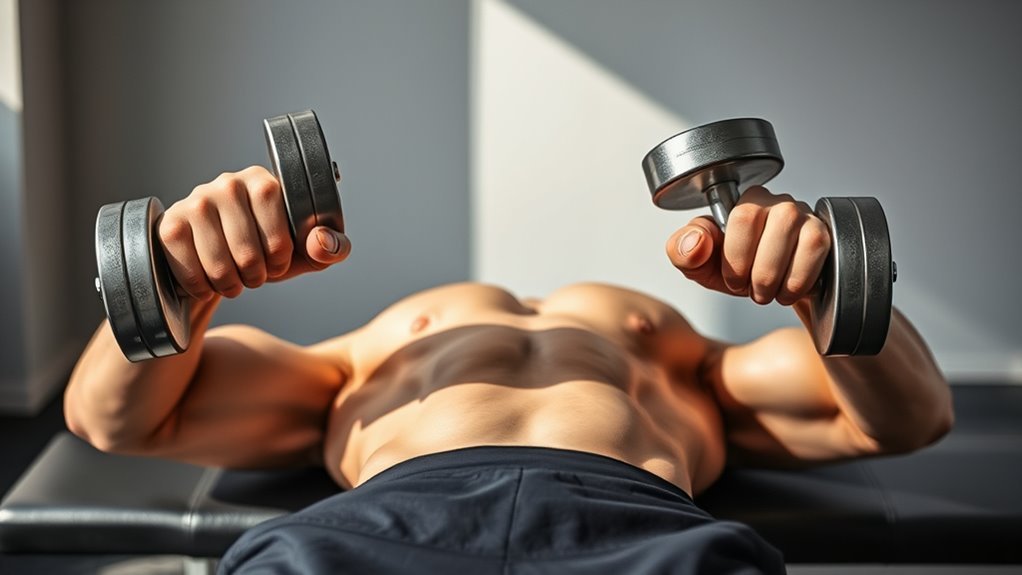
To build strong pecs, you’ll want to focus on essential dumbbell exercises that really target your chest muscles.
The dumbbell chest press is a powerful move to add strength and size. Pair it with different dumbbell fly variations to hit your pecs from multiple angles and maximize growth.
Effective Dumbbell Chest Press
When you want to build strong, defined pecs, the dumbbell chest press offers a versatile and effective solution. This exercise targets your chest muscles while engaging stabilizers for balanced strength.
To perform it correctly, lie on a bench with a dumbbell in each hand, palms facing forward. Press the weights upward until your arms are fully extended.
Then, lower the dumbbells slowly, keeping control and ensuring your elbows bend at about 90 degrees.
Make sure to maintain a slight arch in your back and keep your feet flat on the floor. This helps maximize power and reduce injury risk.
Try to incorporate this move into your routine regularly. Increase the weight as you progress, and watch your pecs grow stronger and more sculpted.
Targeted Dumbbell Fly Variations
Although the dumbbell chest press builds solid strength, incorporating targeted dumbbell fly variations can help you isolate and sculpt your pecs more effectively. Start with the classic flat dumbbell fly to stretch and contract your chest muscles through a wide arc.
To hit different angles, try incline dumbbell flies on a bench set at 30-45 degrees; this variation emphasizes your upper pecs. For a deeper stretch and more control, perform slow negative reps, lowering the weights gradually.
You can also experiment with one-arm dumbbell flies to improve muscle symmetry and engage your core for stability. Remember to keep a slight bend in your elbows to protect your joints.
Integrating these fly variations into your routine will add variety and target your chest muscles from multiple angles, accelerating your pec development. Give them a try and feel the difference!
Proper Form and Technique for Dumbbell Chest Exercises
Mastering proper form and technique is key to maximizing your gains and preventing injury during dumbbell chest exercises. When you execute each movement correctly, you target your pecs efficiently and avoid unnecessary strain.
Follow these essential tips:
- Control Your Movement: Lower the dumbbells slowly and with control, feeling the stretch in your chest without letting momentum take over.
- Maintain a Stable Position: Keep your back flat against the bench and feet planted firmly on the floor to support your body throughout the exercise.
- Use a Full Range of Motion: Bring the dumbbells down until your elbows are at chest level, then press up fully to engage your pec muscles completely.
Stick to these fundamentals, and you’ll build strength safely while making the most of every rep. Just keep at it, and you’ll see the results!
Structuring Your Dumbbell Chest Workout Routine
Now that you’ve got the proper form down, it’s time to organize your dumbbell chest workouts for maximum effectiveness. Start by choosing 3-4 exercises targeting different parts of your chest, such as flat dumbbell presses, incline presses, and flyes.
Aim for 3-4 sets of 8-12 reps per exercise to stimulate muscle growth. Allow 48 hours between sessions to give your muscles time to recover.
Begin each workout with a lighter warm-up set, then move to your working sets with heavier weights. Keep rest periods between 60-90 seconds to maintain intensity while allowing sufficient recovery.
Consistency is key; plan to train your chest 2-3 times weekly. By structuring your routine this way, you’ll build balanced, well-defined pecs efficiently.
Progressive Overload and How to Increase Dumbbell Weight
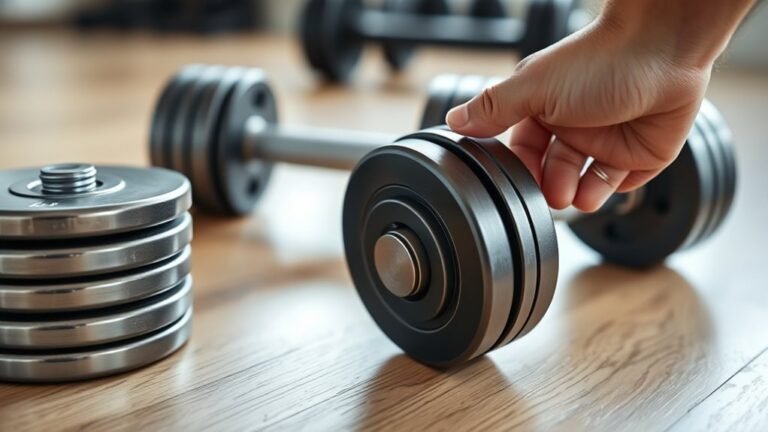
As you continue your chest workouts, increasing the dumbbell weight gradually guarantees your muscles keep adapting and growing stronger.
Progressive overload is essential to avoid plateaus and stimulate muscle growth. Here’s how you can effectively increase your dumbbell weight:
1. Track Your Progress – Record the weights and reps each session.
When you can complete your target reps with good form comfortably, it’s time to increase.
2. Increase in Small Increments**** – Jumping too high can cause injury.
Use the smallest available weight increase, typically 2.5 to 5 pounds.
3. Prioritize Form Over Weight – Never sacrifice proper technique for heavier dumbbells.
Maintain control to maximize muscle engagement and prevent injury.
Common Mistakes to Avoid When Training Pecs With Dumbbells
Increasing your dumbbell weight is important, but it’s just as important to avoid common mistakes that can hinder your chest development or cause injury. Poor form, neglecting warm-ups, and overtraining are frequent errors that limit your progress.
Pay attention to controlled movements, proper range of motion, and balanced workout routines to maximize gains safely. Taking a little extra time to focus on these details really makes a difference.
| Mistake | Why It’s Harmful | How to Fix It |
|---|---|---|
| Using Too Heavy | Sacrifices form, risk of injury | Choose manageable weights |
| Skipping Warm-Up | Increases injury risk | Always warm up with light sets |
| Rapid Reps | Reduces muscle engagement | Perform slow, controlled reps |
| Neglecting Balance | Causes muscle imbalances | Train opposing muscles evenly |
Tips for Maximizing Muscle Growth and Recovery
Although lifting heavier weights challenges your muscles, maximizing growth and recovery depends just as much on how you rest and fuel your body.
Building muscle isn’t just about lifting heavy—rest and nutrition are equally crucial for growth and recovery.
To get the most from your dumbbell pec workouts, focus on these essentials:
- Prioritize Protein Intake: Consume lean proteins within 30 minutes post-workout to repair muscle fibers effectively.
- Get Quality Sleep: Aim for 7-9 hours each night; this is when your body releases growth hormones critical for muscle repair.
- Incorporate Active Recovery: Engage in light activities like walking or stretching on rest days to boost circulation and reduce soreness.
Following these tips guarantees your chest muscles not only grow stronger but recover faster, letting you train consistently without setbacks.
Frequently Asked Questions
Can Dumbbell Pec Exercises Improve Posture?
Yes, dumbbell pec exercises can improve your posture by strengthening your chest muscles. These muscles support your shoulders and upper back.
When your pecs are stronger, it helps you maintain an upright position. This means less slouching and better alignment overall. So, incorporating these exercises can really make a difference in how you carry yourself.
How Often Should I Change My Dumbbell Chest Routine?
Change your dumbbell chest routine every 4-6 weeks to keep things fresh and avoid plateaus.
You don’t want to rest on your laurels; switching up exercises challenges your muscles and sparks new growth.
Mixing things up keeps your workouts interesting and helps you stay motivated.
Are Dumbbell Chest Workouts Safe for Beginners With Shoulder Pain?
Dumbbell chest workouts can be safe if you start light, use proper form, and avoid exercises that aggravate your shoulder pain. Always listen to your body, and consider consulting a healthcare professional before beginning.
It’s all about taking it slow and paying attention to how your shoulders feel. If something hurts, don’t push through it—modify or skip that move. Remember, your goal is to build strength without causing more pain!
What Nutrition Supports Optimal Pec Muscle Growth?
You’ll want to eat plenty of protein like chicken, fish, and eggs to repair muscles. Include healthy fats and complex carbs for energy.
Stay hydrated, and consider supplements like creatine or BCAAs to support muscle growth. These can really give your pec gains a boost!
Can I Build Pecs With Dumbbells at Home Without a Bench?
Absolutely, you can sculpt pecs with dumbbells at home without a bench!
Try floor presses, push-ups with dumbbells, and chest fly variations. Your body and creativity become the bench—turning limitations into muscle-building opportunities.
It’s all about finding ways to make the most of what you have. So get creative and start building those pecs!
Conclusion
Now that you know how to build your pecs with dumbbells, it’s time to put that knowledge into action. Stick to proper form and progressively increase your weights. Avoid common mistakes to sculpt chest muscles that’ll feel like they belong on a superhero.
Remember, consistency and recovery are your secret weapons. Neglect them, and you might as well be trying to move mountains with a feather. Keep pushing, stay focused on your dumbbell chest workouts, and watch your pecs transform into a strong, defined powerhouse.
Building pecs with dumbbells isn’t just about lifting heavy; it’s about smart training and patience. So keep at it, listen to your body, and enjoy the gains that come from dedication and the right routine.